

What Connects Us
Human Continuity in the Informational Age

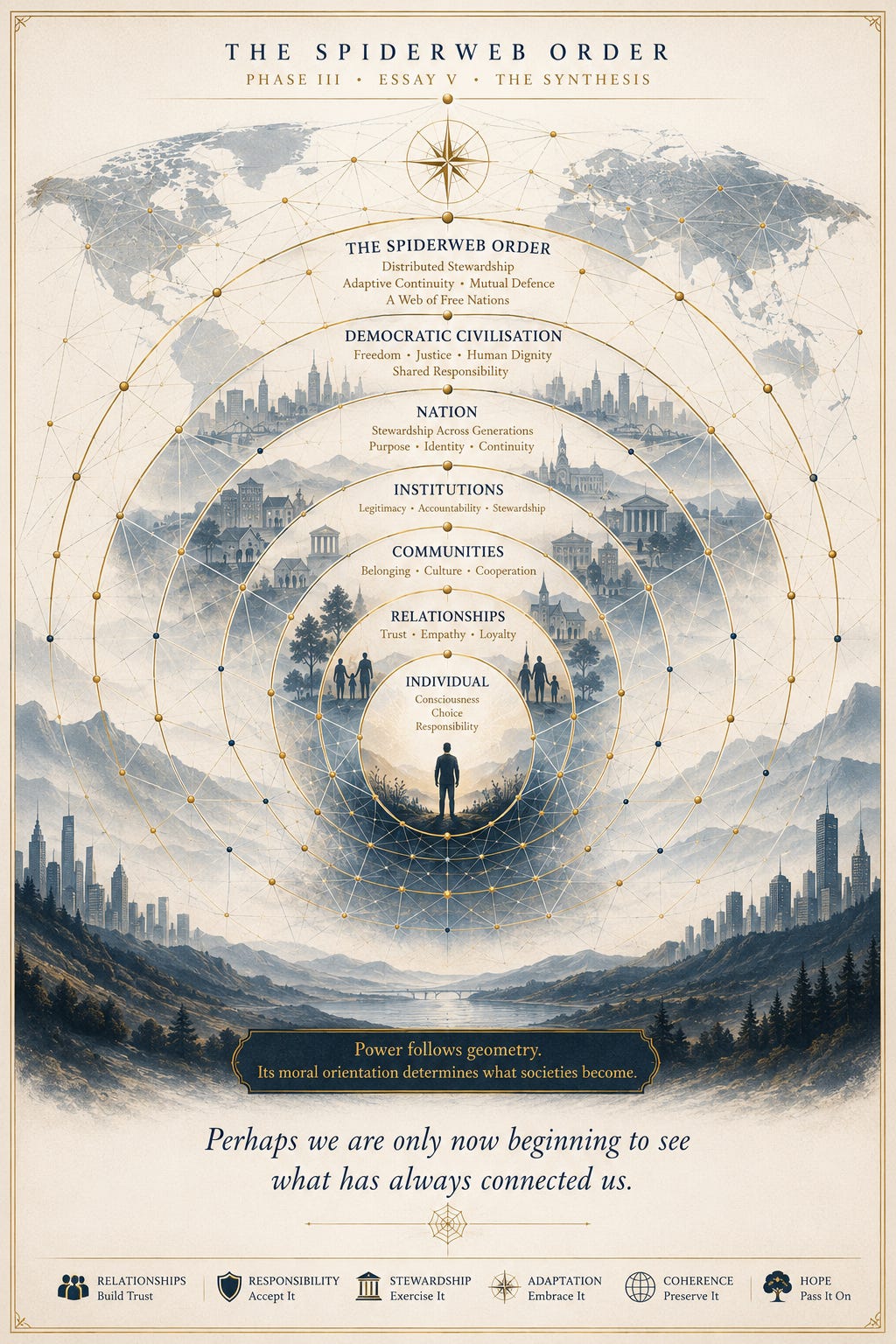
Spiderweb Order — The Synthesis
Phase III, Essay V
Framing Note
The earlier essays in Phase III explored how democratic societies adapt to a changing strategic environment. They examined democratic resilience, legitimacy, stewardship and the widening geometry of responsibility required by an increasingly networked world.
This concluding essay turns inward.
Rather than asking how democratic societies must adapt, it asks what capacities free people must cultivate if democratic civilisation is to continue adapting without losing the values that make it worth defending.
The argument is intentionally human. It begins not with governments or institutions, but with ordinary relationships. From there, it follows widening circles of responsibility through leadership, community, shared reality, nationhood and democratic defence before returning to the broader pattern that has connected the Spiderweb Order from the beginning.
If the previous essays explored how democratic civilisation changes, this final essay explores how we change with it.
This essay is offered as an invitation to see familiar things differently—to recognise the relationships through which democratic civilisation is continually created, renewed and defended.
Introduction
Democracy rarely announces itself in theatrical moments.
More often, it lives quietly in ordinary relationships: neighbours who trust one another, communities willing to participate, people who disagree without becoming enemies, leaders who accept responsibility rather than avoid it, and institutions that continually earn legitimacy rather than simply expect it.
Constitutions, elections and governments remain indispensable. Yet they endure because countless people, often unnoticed, choose each day to sustain the habits that make democratic life possible. Long before democracy is expressed through institutions, it is practised through relationships.
For much of modern history, democratic resilience has been understood through the strength of laws, governments, constitutions and the institutions designed to protect them. These remain essential. They provide continuity, constrain the misuse of power and preserve the freedoms upon which open societies depend.
Yet the strategic environment in which democracies now exist is changing.
Power no longer moves primarily through clearly defined hierarchies. Increasingly, it flows across interconnected networks of people, technologies, institutions, economies and nations. Information travels globally in moments. Influence extends far beyond borders. Decisions made in one society can rapidly shape the security, prosperity and democratic health of another.
These changes have transformed not only the international system, but the everyday experience of democratic life. Citizens are asked to navigate unprecedented volumes of information, competing narratives, accelerating technological change and increasingly complex strategic environments. Many sense that something fundamental has shifted, even if they struggle to describe exactly what has changed.
Throughout history, periods of profound transformation have invited societies to reconsider not only how they organise themselves, but what they ask of the people who inhabit them.
This moment is no different.
What, then, does democracy ask of us?
Perhaps that question cannot be answered by governments alone.
Nor by institutions, technologies or strategic doctrines.
Perhaps its answer emerges more quietly—in the choices people make each day, the relationships they build and the communities they choose to strengthen.
It emerges wherever democratic life is lived rather than merely discussed.
Most of us inherit democracy long before we ever stop to consider what it asks of us.
Every democracy begins somewhere.
It begins with us.
Where Democracy Begins
It is easy to mistake democracy for its institutions.
They matter profoundly. Constitutions, courts, elections and representative government provide the framework within which democratic life can flourish. They preserve rights, constrain power and create the conditions for peaceful self-government.
Yet before democracy is expressed through institutions, it is practised through relationships.
Most people do not wake each morning believing they are defending democracy. They care for a neighbour. They volunteer at a local sporting club. They mentor a young colleague. They comfort a grieving friend. They challenge injustice when they encounter it. They choose honesty when dishonesty would be easier. These actions rarely appear in constitutional documents or political speeches, yet they quietly sustain the social fabric upon which democratic life depends.
Democracy begins wherever ordinary people accept responsibility for something larger than themselves.
Earlier this year, two ordinary citizens, Renée Good and Alex Pretti, demonstrated what this can look like.
Faced with violence directed toward members of their community, neither acted from political ambition nor in pursuit of public recognition. Their response arose from something far simpler and far more profound: an instinctive commitment to their community and to the protection of its people. Stranger and friend, newly naturalised citizen and families whose roots stretched back generations alike all formed part of the social fabric they sought to defend.
Like so many acts of courage throughout history, their actions were not driven by abstract theories of democracy, but by enduring principles of equality, the rule of law and our shared humanity.
In the days, weeks and months that followed, their example resonated far beyond Minnesota. Communities gathered. Neighbours supported one another. Across the United States, people responded not by debating democratic theory, but by quietly reaffirming their commitment to their own communities, workplaces, families and neighbours. They organised. They voted. They stood beside one another. In doing so, they honoured Renée and Alex not simply through words, but by following their example and choosing to protect the communities they called home.
Few would have described these responses as acts of democratic defence.
Yet that is precisely what they were.
Democracy is first practised through relationships.
When relationships are strengthened, trust grows. When trust grows, communities become more resilient. When communities become more resilient, democratic institutions inherit foundations capable of enduring uncertainty, disagreement and change.
The strength of a democracy cannot be measured solely by the quality of its institutions.
It must also be measured by the quality of the relationships from which those institutions continually draw their legitimacy.
Responsibility has a way of widening.
What begins as care for another person gradually becomes influence. Influence exercised with integrity earns trust. Over time, that trust becomes the foundation from which legitimate authority can emerge.
Every widening circle begins with an ordinary person accepting responsibility for something beyond themselves.
When Responsibility Becomes Leadership
Long before responsibility is recognised through titles or institutions, it is often demonstrated by the people around us...
What begins as care for another person gradually becomes influence. Influence exercised with integrity earns trust. Over time, that trust becomes the foundation from which legitimate authority can emerge.
Long before responsibility is recognised through titles or institutions, it is often demonstrated by the people around us.
A parent who nurtures their family. A teacher who quietly shapes the confidence of a child or ignites a sense of purpose. A neighbour who steps forward after recognising a need. A volunteer who continues serving without expectation of recognition. These acts may never carry formal authority, yet they are unmistakably acts of leadership.
Responsibility accepted consistently becomes influence.
Influence exercised with integrity earns trust.
Over time, that trust becomes the foundation from which legitimate authority can emerge.
Leadership is not created by position.
It becomes visible through consistent responsibility.
One of the clearest contemporary examples of this has been Pope Leo.
I am not Catholic. Yet over recent months, I have found myself returning repeatedly to his reflections, not because of the office he holds, but because leadership gradually became visible through the way he inhabits it. Rather than projecting authority, his words and actions consistently reveal an orientation toward humanity.
Whether speaking about migration, conflict, technology or poverty, his attention repeatedly returns to the dignity of the individual person and the quality of our relationships with one another. Reflecting on the relationship between technology and humanity, he observed: “Only genuine relationships and stable connections can build good lives.” It is a deceptively simple statement, yet it reveals something profound. Leadership begins by recognising that people are never instruments to be used, but human beings to be served.
This is leadership as stewardship.
The defining question of every political system is not who possesses power, but toward whom power is ultimately directed.
Whenever legitimate leadership becomes visible, humanity remains at the centre.
This distinction matters because democratic societies often confuse authority with leadership.
Authority may be granted through office.
Leadership must continually earn legitimacy.
Legitimacy allows authority to function.
Democratic maturity requires us to distinguish symbols of authority from demonstrations of integrity.
Titles, uniforms, popularity, wealth and public attention may all project authority. None of them, on their own, establish legitimacy. Legitimacy emerges wherever responsibility is accepted consistently, exercised with integrity and directed toward something larger than personal ambition.
Standards are not obstacles to democracy.
They are how democratic societies preserve legitimacy.
The strength of a democracy depends not only upon the integrity of its leaders, but upon the willingness of its citizens to extend trust thoughtfully, withdraw it when it has been betrayed, and continually distinguish character from performance.
Leadership begins when responsibility is accepted rather than avoided.
Community
Leadership alone is never enough.
No individual, regardless of character or ability, can sustain democratic civilisation in isolation. Leadership may inspire, but communities are where democratic values become habits, where responsibility becomes culture and where societies quietly teach each generation what it means to live together.
Communities are where responsibility becomes culture.
Long before schools, universities or public institutions begin shaping our understanding of the world, communities teach us how to relate to one another. They influence how we resolve disagreement, whether we extend trust or suspicion, whether diversity is welcomed or feared, and whether responsibility is shared or avoided. They shape how we speak about politics, faith and difference. They teach us not simply what to think, but how to live alongside people who think differently.
These habits rarely attract public attention, yet they form the cultural foundations upon which democratic societies either strengthen or gradually erode.
The terrorist attack against Sydney’s Jewish community at Bondi Beach offered a powerful reminder of this truth.
When violence erupted, countless people responded instinctively. Some protected strangers. Others comforted the injured, guided people to safety, opened businesses to shelter those fleeing danger or simply remained beside people who should never have faced such terror alone. Among them was a Syrian refugee who intervened to protect others—not because he held formal authority, but because Bondi had become his community. In that moment, he did not see strangers. He saw people.
Communities reveal themselves most clearly during moments of uncertainty.
What becomes visible is not simply courage, but culture.
These responses are rarely coordinated. They emerge because countless small acts of responsibility have already become normal. Communities quietly cultivate expectations about how people treat one another long before those expectations are ever tested.
Democracy depends upon relationships capable of sustaining free speech, disagreement, trust and cooperation. Those capacities are not created during moments of crisis. They are cultivated through thousands of ordinary interactions occurring every day in homes, workplaces, schools, sporting clubs, places of worship and neighbourhoods.
Strong communities contribute far more than social connection.
They cultivate the habits that allow democratic societies to remain resilient when uncertainty arrives.
As communities strengthen, responsibility widens once again.
The relationships that sustain communities also shape something even more fundamental: our ability to recognise reality together. Without that shared foundation, trust fragments, cooperation becomes increasingly difficult and democratic life itself begins to lose coherence.
Shared Reality
As communities strengthen, responsibility widens once again.
The relationships that sustain communities also shape something even more fundamental: our ability to recognise reality together. Without that shared foundation, trust fragments, cooperation becomes increasingly difficult and democratic life itself begins to lose coherence.
The informational environment has become strategic terrain because it shapes the relationships upon which democratic civilisation depends.
For most of human history, information travelled slowly through families, communities, institutions and trusted relationships. Today we inhabit an information ecosystem characterised by abundance, acceleration, manipulation and continuous competition for human attention. Never before have individuals possessed such immediate access to knowledge. Never before have they been exposed to such sustained efforts to distort perception.
The strategic objective of modern informational warfare is not merely to persuade people to adopt a particular opinion.
It is to weaken their capacity to distinguish reality from narrative.
This distinction matters.
Free societies do not require everyone to think alike.
They require enough shared reality that disagreement remains meaningful.
Democratic coherence is the continuing capacity of a democratic society to remain sufficiently oriented toward reality that free people can continue exercising judgement, sustaining relationships and cooperating despite disagreement and sustained strategic pressure.
This is not a demand for ideological conformity.
It is the preservation of the cognitive relationship between free people and reality itself.
Respect for shared reality is, ultimately, respect for one another.
When citizens lose confidence that truth can be recognised, disagreement gradually becomes impossible to resolve. Institutions lose legitimacy. Communities become increasingly fragmented. Democratic participation gives way to exhaustion, cynicism and tribal competition.
Democratic societies therefore require more than resilient institutions.
They require psychologically resilient citizens.
Citizens capable of remaining oriented toward reality despite continual attempts to manipulate perception. Citizens capable of exercising judgement without surrendering curiosity, humility or compassion. Citizens capable of resisting not only misinformation, but the temptation to abandon reality itself in favour of certainty, identity or outrage.
Democratic defence, therefore, begins long before military conflict.
It begins wherever democratic societies deliberately cultivate the human, civic and institutional capacities that allow free people to remain coherent under sustained strategic pressure.
Shared reality is not simply an informational requirement.
It is the civic space within which democratic civilisation remains possible.
From that shared foundation emerges something larger still.
The nation.
Nation
If democratic coherence depends upon citizens who remain psychologically oriented toward reality, then preserving those capacities cannot be left to individuals alone. Democratic societies require institutions capable of protecting, reinforcing and transmitting them across generations.
It is easy to mistake a nation for its geography, its government or its borders.
These matter. They define sovereignty, provide security and establish the constitutional framework within which democratic life can flourish.
Yet a democratic nation is something more enduring than territory or institutions alone.
A healthy democracy allows its citizens to feel that they belong not only to a place, but to a living continuum of people, principles and responsibilities extending across generations.
There are moments when our place within history quietly becomes visible.
For an instant, we step outside the urgency of the present and recognise that we are part of something much larger than ourselves. We inherit institutions we did not build, freedoms we did not secure, knowledge we did not discover and responsibilities we cannot leave entirely to those who follow.
Citizenship becomes something more than participation in the present.
It becomes stewardship across time.
Perhaps this is why so many people today experience private exhaustion.
The pace of technological change, continual strategic competition and the fragmentation of shared reality can leave democratic societies with the uneasy sense that something fundamental has shifted. Many people no longer feel entirely at home within the nation they inherited, even if they struggle to explain why.
Yet democratic societies have never stood still.
Every generation has inherited new challenges requiring new capacities, new institutions and new forms of cooperation. The present moment is no exception. Our task is not to preserve democracy exactly as we found it, but to carry forward its enduring principles while allowing democratic civilisation to continue adapting to the world it now inhabits.
Ukraine has demonstrated that a nation is more than territory or government.
Under sustained strategic pressure, millions of ordinary citizens have continued teaching children, maintaining communities, preserving culture, supporting one another and defending democratic institutions. In doing so, they have revealed something fundamental: a nation endures not simply because it occupies land, but because its people continue carrying forward the relationships, responsibilities and principles that give democratic life its meaning.
Perhaps this is what nations have always been.
Hope begins to return when we recognise that we are not witnessing the end of democracy, but living through one of its great periods of adaptation. Like every generation before us, we inherit the responsibility to strengthen what is worth preserving, reform what no longer serves the common good and prepare a democratic society for those who will inherit it after us.
Democratic nations do not exist in isolation.
Just as healthy communities strengthen one another through relationships of trust and cooperation, resilient democratic nations contribute to a wider web of stability, knowledge, mutual support and collective stewardship. The strength of the democratic international order ultimately depends upon the health of the democratic societies from which it is woven.
Every generation inherits a democracy it did not create.
Every generation decides what it will become.
Forward Democratic Defence
For much of modern history, democratic societies have understood defence primarily through military capability, territorial security and deterrence. These remain indispensable. A democracy unable to defend its sovereignty cannot preserve the freedoms upon which democratic life depends.
Yet the strategic environment has changed.
Power increasingly operates through interconnected networks rather than clearly defined hierarchies. It moves through information as readily as territory, through economic coercion as readily as military force, through influence, cyber operations and sustained campaigns designed to erode trust long before conventional conflict begins.
Democratic defence must therefore evolve alongside the environment it seeks to protect.
Forward democratic defence begins long before a crisis emerges.
It begins wherever democratic societies deliberately cultivate the human, civic and institutional capacities that allow free people to remain psychologically resilient, civically engaged and strategically coherent. It strengthens institutions before they are tested. It invests in communities before they become fragmented. It develops trusted relationships before they are needed. It reinforces alliances before deterrence is challenged.
This broader understanding transforms defence from a reactive activity into an ongoing civic responsibility.
Ukraine has demonstrated that democratic defence is never the responsibility of armed forces alone. Teachers continued educating children. Engineers restored electricity. Journalists documented truth. Volunteers sustained communities. Local governments continued serving citizens. Democratic institutions continued functioning wherever circumstances allowed. Military resistance defended sovereignty. Civilian stewardship ensured there remained a democratic civilisation worth defending.
Democratic defence is therefore not simply the protection of territory.
It is the deliberate cultivation and protection of the human, civic and institutional capacities that allow free societies to remain coherent under sustained strategic pressure.
This understanding widens responsibility once again.
Citizens, educators, journalists, public servants, researchers, civil society, military professionals and political leaders each contribute to preserving the conditions under which democratic civilisation can continue evolving. Defence becomes not merely the responsibility of governments, but the shared stewardship of democratic society itself.
The same principle extends beyond national borders.
Democracies strengthen one another not only through treaties or military alliances, but through relationships of trust, knowledge, cooperation and mutual stewardship. The resilience of one democratic society increasingly contributes to the resilience of others.
Forward democratic defence is therefore not simply a strategy.
It is the practical expression of democratic stewardship.
And from that stewardship emerges something larger still.
A democratic order sustained not by hierarchy alone, but by relationships.
The Spiderweb Order
Throughout this essay, responsibility has continued to widen.
It began with the ordinary relationships through which democratic life first takes shape. It widened through leadership, where responsibility consistently accepted became legitimacy. It widened again through communities, where responsibility became culture, and through shared reality, where democratic coherence became possible. It widened once more through nations, where stewardship extended across generations, and finally through democratic defence, where preserving democratic civilisation became a shared responsibility.
Each widening circle revealed the same underlying pattern.
Democratic civilisation does not emerge from any one institution, leader or technology. It emerges through relationships of responsibility, trust, stewardship and continual adaptation.
The geometry of power shapes how societies organise themselves.
Its moral orientation determines what those societies ultimately become.
This has always been the central question.
Not who possesses power.
But toward whom power is ultimately directed.
When power turns inward, it seeks status, control and self-preservation. When power turns outward, it becomes stewardship. It protects relationships. It strengthens communities. It cultivates legitimacy. It preserves the conditions under which free people remain capable of governing themselves.
The Spiderweb Order is not a prescription. It is an invitation to recognise the relationships through which democratic civilisation is continually created, renewed and defended.
Every generation inherits moments that feel unprecedented. Yet history reminds us that humanity has always lived through periods of profound transformation. Our generation is no different. The geometry of power is changing. The informational environment is changing. The strategic environment is changing. The capacities democratic societies require are changing.
The responsibility to shape what comes next has not changed.
It still begins where it always has.
With ordinary people.
Perhaps we are only now beginning to see what has always connected us.