

The Credibility Gap
What Ukraine Taught the Indo-Pacific About Strategic Dependence

At this year’s Shangri-La Dialogue, United States Defence Secretary Pete Hegseth delivered a familiar message.
The Indo-Pacific faces a deteriorating security environment.
China continues to expand its military capabilities.
Pressure against Taiwan is increasing.
Regional states must invest more heavily in their own defence.
On the surface, the argument is difficult to dispute.
Deterrence requires capability.
Capability requires investment.
The strategic environment confronting the Indo-Pacific has become considerably more dangerous than it was a decade ago.
Yet there is an uncomfortable contradiction at the heart of Washington’s message.
The same administration urging greater strategic self-reliance among its partners has spent much of the past year demonstrating precisely why those partners increasingly feel compelled to pursue it.
Ukraine may be thousands of kilometres from Taiwan.
But its strategic lessons are already reshaping strategic thinking throughout Asia.
The most important lesson is not about defence spending.
It is about dependence.
For decades, many states across the Indo-Pacific organised their security around a relatively straightforward assumption.
The United States would remain the region’s principal strategic guarantor.
Whether one agreed with every decision made in Washington was often secondary. Governments changed. Policies shifted. Priorities evolved.
Yet the broader architecture remained remarkably stable.
American power provided predictability.
Predictability provided confidence.
Confidence enabled long-term planning.
That assumption now appears less certain than it once did.
This is not because the United States has become weak.
Far from it.
The United States remains the most powerful military actor in the international system by a considerable margin.
Nor is this an argument that Washington will necessarily abandon its allies in a future crisis.
The problem is more subtle.
Strategic planning depends not only upon power, but upon predictability.
States do not prepare solely for what their partners are capable of doing.
They prepare for what they can reasonably expect those partners to do.
Recent events have complicated that calculation.
Military assistance to Ukraine became entangled in domestic political competition.
Weapons deliveries were delayed.
Intelligence support was temporarily suspended.
Long-standing commitments became subjects of partisan dispute.
None of these developments occurred in Asia.
Yet governments throughout the region were watching carefully.
The lesson many drew was not that alliances had failed.
The lesson was that alliances themselves could become sources of uncertainty.
This distinction matters.
Perhaps more than many Western policymakers realise.
Throughout the Cold War and much of the post-Cold War era, smaller and middle powers often organised their security around access to a sufficiently powerful patron.
The logic was straightforward.
If a threat emerged, the guarantor would respond.
If deterrence failed, the guarantor would intervene.
The arrangement was never perfect, but it provided a degree of strategic clarity.
Ukraine has forced many governments to reconsider that model.
Not because support ultimately disappeared.
But because support became conditional upon factors beyond the control of the state depending upon it.
Domestic politics.
Electoral cycles.
Legislative disputes.
Leadership transitions.
Strategic priorities.
The guarantor itself became a variable.
For countries living in the shadow of China, this represents a profound shift.
The challenge facing the Indo-Pacific is no longer simply how to deter Beijing.
The challenge is how to maintain deterrence when even powerful allies may become temporarily distracted, politically constrained, or strategically uncertain.
This is the credibility gap.
It is not a gap between American rhetoric and American capability.
It is a gap between capability and predictability.
And that gap is increasingly shaping how regional states think about security.
Ukraine Changed More Than Europe
Western discussions of Ukraine often focus on Europe.
This is understandable.
The war is taking place on European soil.
Its consequences have transformed European defence planning, energy policy, industrial production, and alliance cohesion.
Yet one of the war’s most important strategic effects may have occurred far beyond Europe itself.
Ukraine changed how middle powers think.
For decades, many states assumed that security ultimately flowed outward from a small number of powerful capitals.
Washington.
Brussels.
Perhaps London.
In times of crisis, these centres would coordinate responses, mobilise resources, and preserve stability.
Ukraine exposed a more complicated reality.
Even when broad political support exists, democratic systems move through elections, legislatures, competing priorities, budget negotiations, and shifting public opinion.
Support can be delayed.
Debated.
Interrupted.
Modified.
Contested.
None of this is evidence of democratic weakness.
It is simply how democratic systems function.
Yet from the perspective of states facing immediate security challenges, the implications are significant.
A government in Taipei cannot control elections in Washington.
A government in Manila cannot shape congressional negotiations.
A government in Canberra cannot determine the outcome of American domestic political debates.
If national survival depends entirely upon decisions made elsewhere, vulnerability inevitably follows.
This does not mean alliances are obsolete.
Nor does it suggest that regional states should seek strategic independence.
Such ambitions are neither realistic nor desirable.
The lesson emerging from Ukraine is something more practical.
Resilience increasingly depends upon reducing fragility.
The strongest security architecture is not necessarily the one with the most powerful centre.
It may be the one capable of functioning when the centre becomes distracted.
That distinction may prove increasingly important as the Indo-Pacific enters a period of growing strategic competition.
The question facing the region is therefore not whether the United States remains indispensable.
The question is whether regional security can be organised in ways that remain effective even when uncertainty emerges at the centre of the system itself.
What If The Region Had To Hold?
For decades, strategic planning in the Indo-Pacific has often begun with a familiar assumption.
If a major crisis emerged, American intervention would eventually shape the outcome.
The assumption may ultimately prove correct.
Yet Ukraine has demonstrated the danger of building security architectures around expectations alone.
The lesson is not that alliances fail.
The lesson is that time matters.
Political decisions require time.
Military mobilisation requires time.
Industrial production requires time.
Democratic systems require time.
The opening weeks of a crisis may therefore prove decisive.
This raises an uncomfortable but increasingly important question:
What if the region had to hold?
Not permanently.
Not alone.
But long enough for broader coalitions, industrial capacity, and diplomatic responses to mobilise.
Such a scenario requires thinking about deterrence differently.
The objective is no longer simply preventing conflict through military strength.
It becomes creating a strategic environment in which aggression encounters resistance across multiple domains simultaneously.
Military.
Economic.
Industrial.
Political.
Informational.
The challenge facing China would not be defeating a single adversary.
It would be managing a complex network of obstacles operating across an entire region.
The distinction matters.
Historically, great powers often seek decisive points of failure.
A capital city.
A military headquarters.
A fleet.
An alliance leader.
A single centre of gravity whose disruption creates wider collapse.
Networked systems behave differently.
They absorb shocks.
Adapt.
Re-route.
Compensate.
Recovery becomes possible because resilience exists throughout the system rather than being concentrated in a single location.
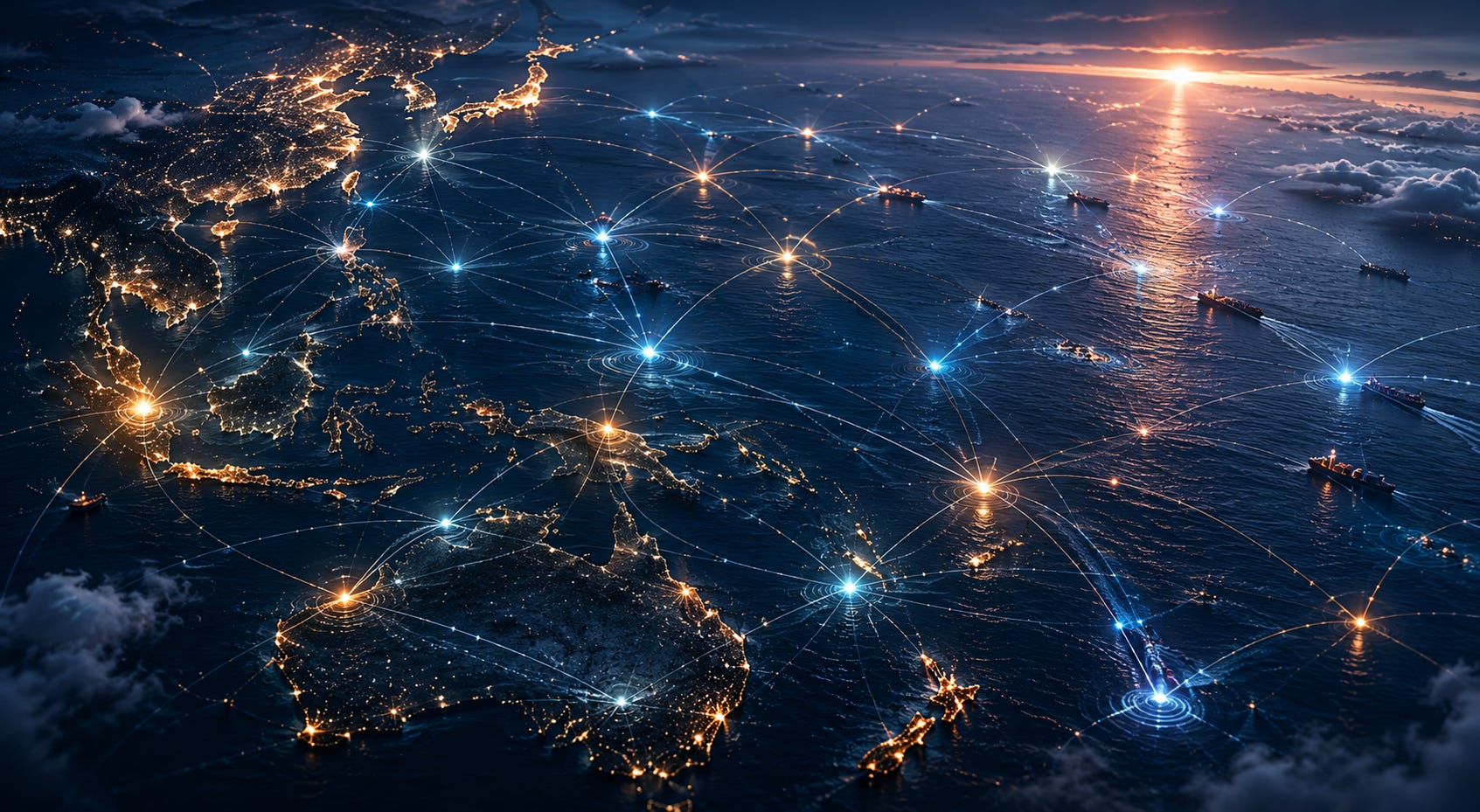
The question facing Indo-Pacific states may therefore be less about constructing a stronger shield and more about creating a denser web.
Regional Economic Denial
Much discussion surrounding economic deterrence focuses upon sanctions.
This is understandable.
Sanctions are visible.
Governments can announce them.
Markets respond to them.
Political leaders can point to them as evidence of action.
Yet sanctions imposed after conflict begins may already be too late.
The more important challenge concerns economic resilience before conflict occurs.
China’s economy is vast.
It remains the manufacturing centre of much of the global economy and an indispensable trading partner for many states throughout the region.
Yet scale does not eliminate vulnerability.
In some respects, it can create new forms of dependency.
China remains heavily reliant upon imported energy.
It depends upon external markets to absorb significant portions of its industrial output.
Advanced semiconductor technologies remain linked to international supply chains.
Its financial system remains connected to global capital flows.
Its manufacturing economy relies upon complex networks extending far beyond its borders.
The strategic implication is straightforward.
Regional states need not match China’s economic size to complicate Chinese decision-making.
They need only reduce the effectiveness of economic coercion.
This begins with diversification.
Supply chains become harder to disrupt when production is distributed.
Energy shocks become less severe when strategic reserves and alternative suppliers exist.
Technology restrictions become more effective when they are coordinated before a crisis rather than improvised during one.
Financial resilience improves when regional partners establish contingency arrangements capable of maintaining liquidity and commercial continuity under stress.
None of these measures are dramatic.
None attract headlines.
Yet collectively they alter strategic calculations.
The objective is not economic warfare.
It is reducing vulnerability.
A state that cannot easily be coerced becomes more difficult to intimidate.
A region capable of absorbing disruption becomes less attractive as a target.
Deterrence, in this sense, begins long before the first missile is launched.
Maritime Containment
China’s rise is frequently described in continental terms.
Population.
Industrial output.
Economic scale.
Military expansion.
Yet China’s prosperity ultimately depends upon maritime access.
This reality creates one of the central strategic paradoxes of the Indo-Pacific.
China is an enormous continental power operating within a profoundly maritime environment.
Its economy relies heavily upon imported energy.
Much of its trade passes through maritime chokepoints stretching from the Indian Ocean through Southeast Asia.
Its export-driven economy depends upon access to sea lanes connecting it to global markets.
Its naval expansion reflects an awareness of this reality.
So too should regional planning.
The objective would not be blockade.
Nor would it be an attempt to sever maritime commerce entirely.
Such ambitions would likely prove unsustainable and dangerously escalatory.
Instead, regional states could focus upon increasing operational complexity.
Persistent surveillance.
Expanded anti-submarine networks.
Shared maritime domain awareness.
Protection of critical shipping routes.
Coordination between naval and coast guard forces.
Distributed basing arrangements.
Redundant logistics infrastructure.
None of these measures individually transform the balance of power.
Collectively, however, they increase uncertainty.
And uncertainty has strategic value.
Military planning becomes more difficult when visibility increases.
Coercion becomes more expensive when multiple actors contribute to resistance.
Aggression becomes less attractive when maritime dominance cannot be assumed.
The purpose is not confrontation.
It is denial.
The objective is not to control the maritime environment absolutely.
It is to ensure that no actor can control it easily.
In strategic terms, these are very different things.
Distributed Intelligence
One of the most important lessons of Ukraine has been the value of information.
Military capability matters.
Information often determines how effectively that capability can be used.
Throughout the war, intelligence-sharing networks have repeatedly provided Ukraine with advantages that extend beyond traditional military power alone. Early warning, targeting data, battlefield awareness, satellite imagery, cyber intelligence, and open-source analysis have all contributed to a richer understanding of the operating environment.
The result has been a recurring reminder of a simple strategic truth:
The side that sees first often adapts first.
For the Indo-Pacific, this lesson carries profound implications.
No single regional state possesses complete situational awareness.
Nor should it be expected to.
The geography involved is simply too vast.
The Indo-Pacific stretches across thousands of kilometres of ocean, encompasses multiple maritime chokepoints, and contains some of the world’s busiest trade routes.
No single nation can effectively monitor the entire theatre.
Collectively, however, the picture looks very different.
Japan monitors activity in Northeast Asia and the East China Sea.
Taiwan observes developments across the Taiwan Strait.
The Philippines occupies a critical position along the first island chain.
Australia provides surveillance across vast southern and maritime approaches.
India maintains growing visibility across the Indian Ocean.
Singapore functions as an important logistical, technological, and informational hub.
Individually, each perspective remains incomplete.
Together, they begin to form something much more powerful.
A distributed intelligence architecture.
The objective would not necessarily be the creation of a formal NATO-style intelligence structure.
Indeed, attempting to replicate Cold War institutions may miss the realities of twenty-first-century competition.
Instead, regional states could pursue overlapping networks of cooperation.
Shared maritime domain awareness.
Satellite data sharing.
Joint cyber threat monitoring.
Coordinated analysis centres.
Common operating pictures.
Commercial intelligence partnerships.
Open-source intelligence integration.
Artificial intelligence-assisted data fusion.
Information sharing does not require political integration.
It requires trust, interoperability, and continuity.
This distinction matters.
A resilient intelligence network does not depend upon any single state possessing perfect information.
It depends upon many states contributing partial information.
The network becomes stronger precisely because no single node controls it.
Should one node be degraded, constrained, or disrupted, the wider system continues functioning.
The picture may become less complete.
It does not disappear.
This is increasingly important because modern conflict is unlikely to begin with an obvious declaration of war.
The warning signs may emerge gradually.
Cyber intrusions.
Disinformation campaigns.
Economic pressure.
Military exercises.
Maritime harassment.
Infrastructure disruptions.
Political interference.
The challenge is not merely responding to aggression.
It is recognising aggression while it is still unfolding.
A distributed intelligence network increases the likelihood that these signals are detected early enough to matter.
Strategic surprise becomes more difficult when many eyes are watching.
Distributed Industrial Capacity
If Ukraine has shattered one assumption held by many Western strategists, it is the belief that modern wars are decided primarily by technological sophistication.
Technology matters.
Precision matters.
Innovation matters.
But production matters too.
Perhaps more than many policymakers realised.
The war has repeatedly demonstrated that industrial endurance remains a decisive strategic factor.
Drones are consumed.
Missiles are expended.
Vehicles are destroyed.
Barrels wear out.
Supply chains become strained.
Stockpiles shrink.
The side capable of replacing losses retains options.
The side incapable of doing so gradually loses them.
For decades, many advanced economies operated on assumptions shaped by efficiency rather than resilience.
Supply chains became globalised.
Manufacturing became concentrated.
Redundancy was often viewed as waste.
Inventory was reduced.
Production capacity was optimised for peacetime economics.
These approaches generated considerable prosperity.
They may prove less effective under conditions of prolonged strategic competition.
The challenge facing the Indo-Pacific is therefore not simply military preparedness.
It is industrial preparedness.
A regional deterrence architecture capable of enduring crisis cannot rely exclusively upon existing stockpiles.
It requires the capacity to replenish them.
This is where distributed industrial capacity becomes strategically significant.
Rather than concentrating production within a handful of critical locations, regional states could increasingly specialise while remaining interconnected.
One state may focus upon advanced semiconductors.
Another upon drone manufacturing.
Another upon naval construction.
Another upon missile components.
Another upon maintenance and repair.
Another upon logistics and transportation.
The objective is not duplication.
Nor is it complete self-sufficiency.
The objective is redundancy.
A resilient system possesses multiple pathways to achieve the same outcome.
If one production node is disrupted, others continue functioning.
If one supply chain fails, alternatives exist.
If one state faces coercion, the broader network absorbs part of the shock.
This approach offers advantages beyond wartime production.
It also strengthens deterrence itself.
Strategic planners in Beijing would be forced to consider a difficult reality.
Disrupting one facility would not halt production.
Targeting one country would not dismantle the network.
Economic coercion against one partner would not necessarily fracture regional capacity.
The system survives because capability is distributed.
In many respects, this mirrors the logic underpinning modern digital networks.
The internet was designed to survive disruption by routing around damaged nodes.
Resilient industrial systems can function similarly.
No single point of failure.
No single decisive target.
No single disruption capable of producing systemic collapse.
This may ultimately represent one of the most important lessons emerging from Ukraine.
Industrial resilience is no longer merely an economic concern.
It is a strategic capability.
And in a prolonged crisis, the ability to sustain production may prove every bit as important as the ability to win battles.
Wars are not won solely by those who fight well.
They are often won by those who endure longest.
Political Resilience
Military capability is often visible.
Political resilience is not.
Yet history repeatedly demonstrates that political cohesion can prove just as important as military strength during periods of strategic competition.
A nation may possess advanced weapons, sophisticated intelligence services, and substantial economic resources.
If its political system becomes paralysed, divided, or incapable of making timely decisions, those advantages become increasingly difficult to translate into strategic action.
This reality is particularly relevant in the Indo-Pacific.
The region is not a unified political bloc.
It is a diverse collection of democracies, constitutional monarchies, hybrid systems, developing states, advanced economies, and societies with very different political traditions, historical experiences, and strategic priorities.
This diversity is one of the region’s strengths.
It is also one of its vulnerabilities.
The challenge facing regional states is not merely how to deter military aggression.
It is how to maintain political coherence under conditions of sustained pressure.
Modern authoritarian competition increasingly operates across multiple domains simultaneously.
Military power remains important.
Yet it is rarely employed in isolation.
Economic coercion.
Cyber operations.
Disinformation campaigns.
Political influence activities.
Elite capture.
Strategic corruption.
Social media manipulation.
Narrative warfare.
Legal pressure.
Proxy networks.
These mechanisms often seek the same objective.
Not conquest.
Disruption.
The goal is frequently not to defeat a society outright.
It is to make coordinated action more difficult.
To increase hesitation.
To deepen mistrust.
To create paralysis.
The most effective form of deterrence may therefore begin long before any military confrontation occurs.
It begins with political resilience.
Recent political instability in South Korea provides a useful reminder of how rapidly domestic crises can consume strategic attention. Governments become focused inward. Political energy is redirected toward domestic conflict. Decision-making slows. Public trust erodes. Strategic priorities become contested.
Whether such events emerge organically or are subsequently amplified by external actors, the effect can be similar.
Strategic bandwidth becomes constrained.
A distracted state becomes a less effective partner.
A polarised society becomes easier to pressure.
A government struggling to maintain internal legitimacy often finds it more difficult to project confidence externally.
This dynamic has implications far beyond any single country.
Modern alliances and partnerships are often only as resilient as their most politically vulnerable members.
If key states become paralysed, uncertainty spreads throughout the wider network.
Adversaries understand this.
They do not necessarily need to defeat an alliance militarily.
They may simply need to undermine confidence in the alliance’s ability to act collectively.
This is where resilience becomes a networked problem rather than a purely national one.
The traditional approach to alliance management often assumes that political stability exists within participating states.
The emerging strategic environment increasingly requires planning for the opposite.
Periods of political turbulence are no longer exceptional events.
They are becoming recurring features of democratic governance.
Elections.
Leadership transitions.
Coalition disputes.
Economic shocks.
Information campaigns.
Social fragmentation.
These pressures will continue.
The question is not whether they occur.
The question is whether regional systems can continue functioning while they occur.
This requires a different model of resilience.
Rather than assuming every partner remains politically stable at all times, regional states may need to develop mechanisms capable of maintaining continuity when individual governments become distracted, constrained, or temporarily paralysed.
In practical terms, this could involve expanding professional military-to-military relationships, strengthening intelligence-sharing arrangements, increasing bureaucratic interoperability, developing standing coordination mechanisms, and creating continuity structures that survive electoral cycles and leadership changes.
The objective is not to reduce democratic accountability.
Nor is it to insulate governments from political change.
Political diversity remains one of the defining characteristics of open societies.
The objective is continuity.
A resilient regional architecture should not depend entirely upon the decisions of any single leader, government, or electoral cycle.
Just as distributed intelligence reduces reliance upon a single source of information, political resilience reduces reliance upon a single centre of decision-making.
The broader network remains functional even when individual nodes experience disruption.
This may ultimately prove one of the most important strategic lessons of the twenty-first century.
Authoritarian systems frequently seek advantage through concentration.
Concentration of authority.
Concentration of information.
Concentration of decision-making.
Yet concentration also creates vulnerability.
When a single point fails, the wider system often struggles to adapt.
Resilient democratic systems operate differently.
Their strength emerges not from uniformity but from redundancy.
Not from control but from continuity.
Not from eliminating disagreement but from preserving cooperation despite disagreement.
The challenge facing the Indo-Pacific is therefore larger than military deterrence alone.
It is whether diverse societies can sustain strategic coordination despite inevitable political turbulence.
If they can, the region becomes considerably more difficult to coerce.
If they cannot, military power alone may prove insufficient.
In an era of multidomain competition, political resilience is no longer merely a domestic concern.
It is a strategic capability.
The lesson of Ukraine is not that democracies require stronger patrons.
It is that democracies require stronger networks.
Deterrence Through Distribution
The challenge confronting the Indo-Pacific is often framed in military terms.
How many ships?
How many missiles?
How many aircraft?
How many defence dollars?
These questions matter.
But they can also obscure a more important reality.
Modern deterrence is increasingly determined by systems rather than platforms.
The strategic challenge facing China is not simply whether it can defeat a particular military force.
It is whether it can successfully coerce an entire regional ecosystem.
This distinction is significant.
For decades, security architectures throughout the Indo-Pacific were built around a relatively simple assumption.
A sufficiently powerful centre would preserve stability.
American military power acted as the principal deterrent.
Regional states aligned around that centre.
The model was logical.
The United States possessed unmatched military capabilities.
Its forward presence underpinned regional security.
Its alliances created confidence.
Yet every system organised around a central node contains an inherent vulnerability.
If the centre becomes distracted, constrained, politically divided, or strategically uncertain, the wider system begins to feel the effects.
This is precisely the lesson many governments drew from Ukraine.
Not that American power is disappearing.
But that dependence upon any single source of power inevitably creates risk.
The challenge is therefore not replacing American leadership.
It is reducing systemic fragility.
This is where the mechanisms discussed throughout this essay begin to matter.
Economic resilience.
Maritime awareness.
Intelligence sharing.
Industrial capacity.
Political continuity.
Viewed individually, each appears limited.
None is decisive.
None fundamentally alters the balance of power on its own.
Collectively, however, they create something much more significant.
They create strategic depth.
A crisis affecting one state does not immediately disable the wider system.
A political transition in one capital does not paralyse regional coordination.
Disruption of one supply chain does not halt production.
Pressure applied against one partner does not necessarily fracture the network.
Resilience emerges from the relationships between nodes rather than the strength of any single node itself.
At its core, the strategic challenge is surprisingly simple. States that can be isolated become vulnerable. States that remain connected become more difficult to coerce. The contest increasingly revolves around whether pressure can sever connections faster than resilient networks can reinforce them.
This presents a difficult challenge for Beijing.
China has spent decades studying the strengths and weaknesses of American military power.
It has invested heavily in capabilities designed to complicate intervention.
Anti-ship missiles.
Long-range strike systems.
Cyber capabilities.
Space capabilities.
Integrated air defence networks.
The objective has been clear.
Increase the cost of intervention.
Delay decision-making.
Create uncertainty.
Yet a distributed regional system presents a different problem.
There is no single fleet to target.
No single headquarters to disable.
No single alliance leader to pressure.
No single point of failure capable of producing strategic collapse.
Instead, Beijing would confront a network of states contributing different forms of resistance simultaneously.
Some would provide intelligence.
Others logistics.
Others industrial production.
Others economic coordination.
Others maritime surveillance.
Others political support.
No individual contribution may appear decisive.
Together, however, they create friction.
And friction has strategic value.
The objective is not necessarily to defeat China outright.
It is to make aggression increasingly expensive, increasingly uncertain, and increasingly difficult to sustain.
This reflects a broader lesson emerging from Ukraine.
Wars are rarely decided by military capability alone.
They are shaped by endurance.
By adaptation.
By the ability of societies, institutions, economies, and partnerships to continue functioning under pressure.
The side capable of sustaining resistance often proves more difficult to defeat than initial assessments suggest.
This may ultimately become one of the defining strategic questions of the Indo-Pacific.
Can the region evolve from a collection of security consumers into a network of security contributors?
Can resilience be distributed rather than concentrated?
Can deterrence be strengthened not simply through greater military expenditure, but through deeper strategic integration?
If so, the region’s security architecture may become considerably more durable.
Not because it rests upon a stronger centre.
But because it becomes less dependent upon one.
The future of deterrence may not belong to the strongest pillar.
It may belong to the strongest web.
Conclusion: Don’t Panic. Prepare.
The debate sparked at Shangri-La ultimately misses the deeper question.
The future of Indo-Pacific security will not be determined solely by defence budgets, military platforms, or political speeches.
Nor will it be determined by whether the United States remains the world’s most powerful military actor.
The more important question is whether regional states are prepared for a world in which strategic uncertainty becomes a permanent feature of international politics.
Ukraine has exposed an uncomfortable reality.
Even strong alliances can experience friction.
Even committed partners can become distracted.
Even powerful guarantors can become constrained by domestic politics, competing priorities, or changing administrations.
This is not a criticism of democratic systems.
It is simply a recognition of how democratic systems function.
The lesson is not that alliances have failed.
The lesson is that resilience cannot be outsourced.
For decades, many states organised their security around access to power.
The emerging strategic environment increasingly rewards something different.
Adaptability.
Redundancy.
Continuity.
Resilience.
The ability to absorb disruption without losing coherence.
The ability to continue functioning when individual systems falter.
The ability to sustain deterrence through cooperation rather than dependence.
This is particularly important when considering China.
Too much analysis oscillates between two extremes.
Complacency.
Or panic.
Neither is useful.
China is a formidable strategic competitor.
Its military modernisation is real.
Its economic influence is substantial.
Its capacity to exert pressure across multiple domains continues to grow.
These realities should be taken seriously.
They should not, however, be treated as evidence of inevitability.
Strategic outcomes are not predetermined.
They are shaped by choices.
By preparation.
By adaptation.
By the willingness of states to recognise emerging realities before crises force those realities upon them.
The Indo-Pacific possesses significant advantages of its own.
Advanced economies.
Sophisticated militaries.
Innovative industries.
Strong institutions.
Deep partnerships.
Vast collective resources.
Most importantly, it possesses diversity.
A diversity of capabilities, perspectives, and strengths that no single state could replicate alone.
The challenge is not creating a regional hegemon capable of matching China.
The challenge is creating a regional system capable of withstanding pressure.
A system in which economic coercion becomes harder.
Political disruption becomes less effective.
Industrial production becomes more resilient.
Intelligence becomes more distributed.
Maritime pressure becomes more difficult to sustain.
A system capable of continuing to function even when individual nodes experience disruption.
The lesson of Ukraine is not that democracies require stronger patrons.
It is that democracies require stronger networks.
The future of regional security may not rest upon any single capital, alliance, or guarantor.
It may rest upon webs of states capable of sustaining one another when individual nodes falter.
That future remains entirely achievable.
But it requires a shift in mindset.
From dependence to resilience.
From reaction to preparation.
From concentration to distribution.
The challenge facing the Indo-Pacific is therefore not whether it should panic.
It should not.
The challenge is whether it is willing to prepare.
Because the strongest deterrent is rarely fear.
It is readiness.
And the societies that endure are rarely those that wait for certainty.
They are the ones that prepare for uncertainty before it arrives.
The future of Indo-Pacific security may depend less on the strength of individual states than on the strength of the connections between them.