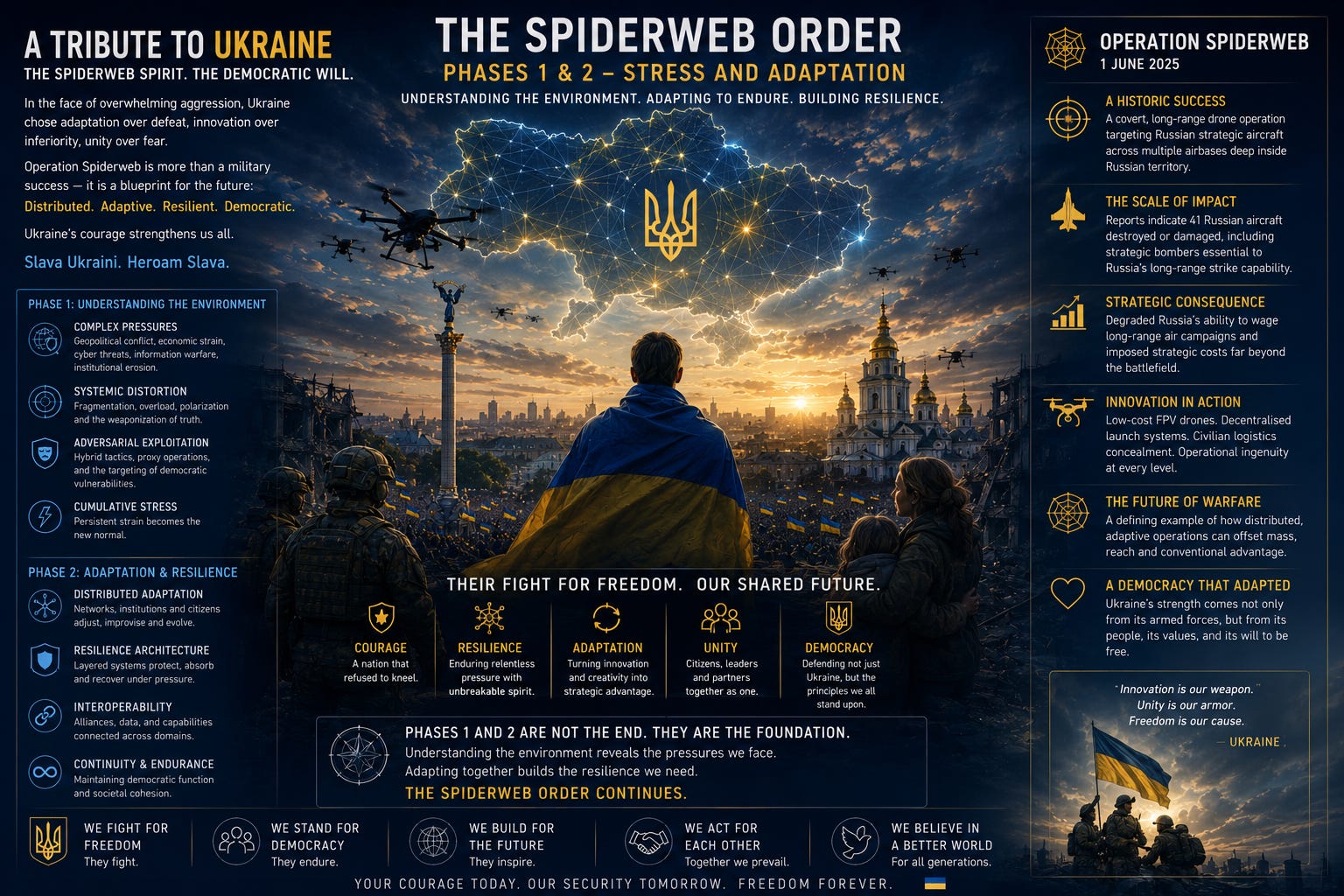
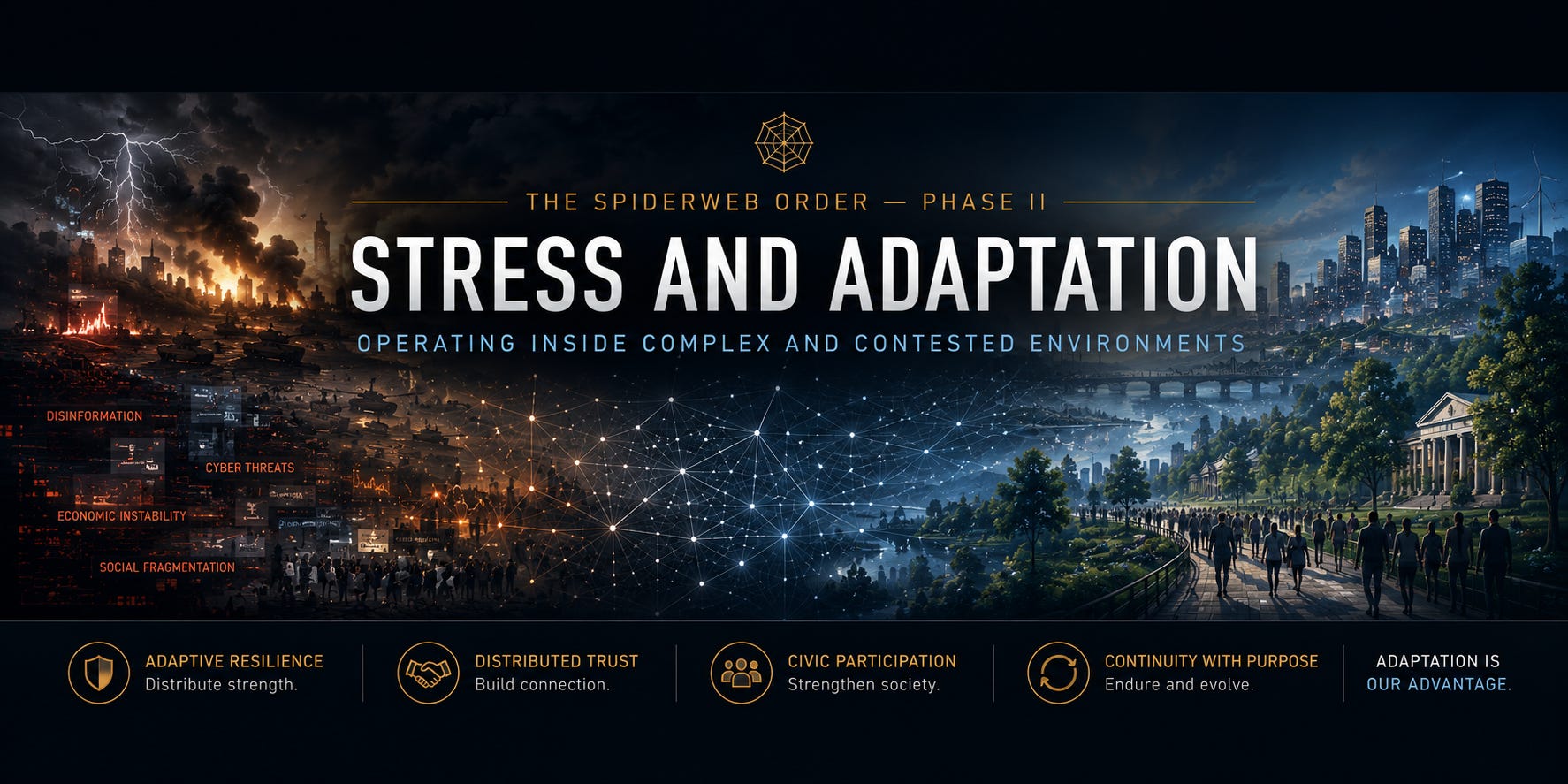
Stress and Adaptation
Operating Inside Complex and Contested Environments

Across much of the democratic world, societies increasingly exist inside a state of permanent strategic tension.
The pressure rarely arrives all at once.
Instead it accumulates gradually through overlapping crises that never fully conclude before new disruptions emerge.
A pandemic gives way to inflation pressure.
Economic instability overlaps with geopolitical escalation.
Cyberattacks target hospitals, infrastructure, and public institutions while disinformation ecosystems intensify political distrust and social fragmentation simultaneously.
Wars once considered geographically distant increasingly reshape:
energy systems,
supply chains,
elections,
industrial policy,
technological competition,
and alliance behaviour across entire regions.
The system no longer experiences disruption as interruption.
It increasingly experiences disruption as atmosphere.
For much of the post-Cold War era, democratic societies largely operated inside a strategic rhythm built around interruption and recovery.
Crises emerged.
Systems stabilised.
Recovery followed.
That rhythm increasingly appears to be breaking down.
The defining challenge of the emerging era may not simply be disruption itself, but the disappearance of stable recovery periods between crises.
The issue is no longer whether democratic societies can avoid instability altogether.
It is whether they can remain adaptive while instability itself becomes persistent.
Earlier Spiderweb essays explored the growing pressures reshaping networked civilisation and the increasing fragility created by concentrated systems operating under continuous strain.
What now becomes increasingly visible is how democratic societies themselves begin adapting behaviourally, operationally, and institutionally under those same conditions.
Because prolonged instability does not merely reshape institutions.
It reshapes:
behaviour,
civic trust,
expectations,
governance,
social cohesion,
and democratic culture itself.
The Spiderweb Order increasingly emerges within this environment not as ideological aspiration, but as democratic adaptation under persistent strain.
I — When Stress Becomes Structural
For many societies, instability no longer feels exceptional.
It increasingly feels ambient.
Citizens move from pandemic disruption to inflation pressure, from geopolitical escalation to information saturation, from political polarisation to economic uncertainty without fully recovering between each successive shock.
The psychological effect is cumulative.
So too are the institutional consequences.
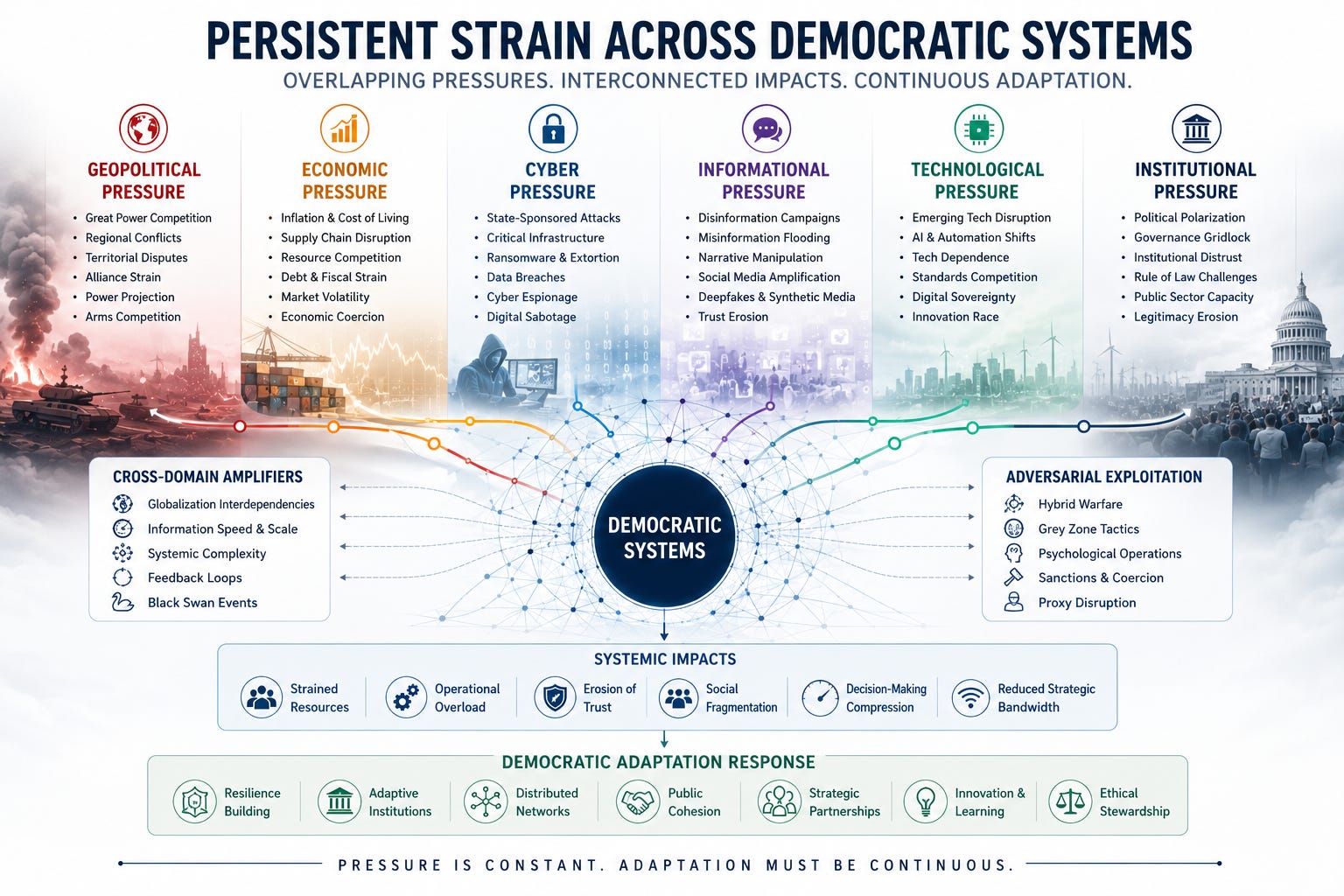
Stress now propagates continuously across interconnected systems:
financial networks,
logistics pathways,
cyber infrastructure,
alliance ecosystems,
information environments,
and public legitimacy systems simultaneously.
The system no longer fully returns to equilibrium before new pressures emerge.
The war in Ukraine reshaped energy systems across Europe while simultaneously accelerating defence restructuring, industrial adaptation, and alliance coordination. Conflict in the Red Sea disrupted shipping routes already strained by supply-chain fragmentation following the pandemic years. Semiconductor competition increasingly intersects with national security policy, technological sovereignty, and geopolitical rivalry at the same time that democratic societies face rising internal political exhaustion.
Pressure accumulates across multiple domains simultaneously.
This produces:
cumulative fatigue,
compressed decision cycles,
adaptation overload,
and continuous strategic recalibration.
Most importantly, persistent stress begins altering system behaviour itself.
Institutions originally designed for periodic disruption increasingly struggle when disruption becomes continuous.
Recovery intervals shrink.
Strategic bandwidth narrows.
Public exhaustion accumulates.
Adaptive pressure intensifies.
This is the transition point between:
temporary crisis management
and:
permanent adaptive operation.
The Hybrid Order therefore represents more than geopolitical instability alone.
It represents a structural condition where democratic systems increasingly operate under overlapping pressure without fully stabilising between successive disruptions.
II — The Limits of Concentrated Control
For decades, many democratic systems prioritised:
efficiency,
optimisation,
centralisation,
and concentrated coordination structures designed for stability-era conditions.
Under stable environments, these systems often delivered extraordinary productivity and economic expansion.
During stable periods, efficiency often appears synonymous with strength.
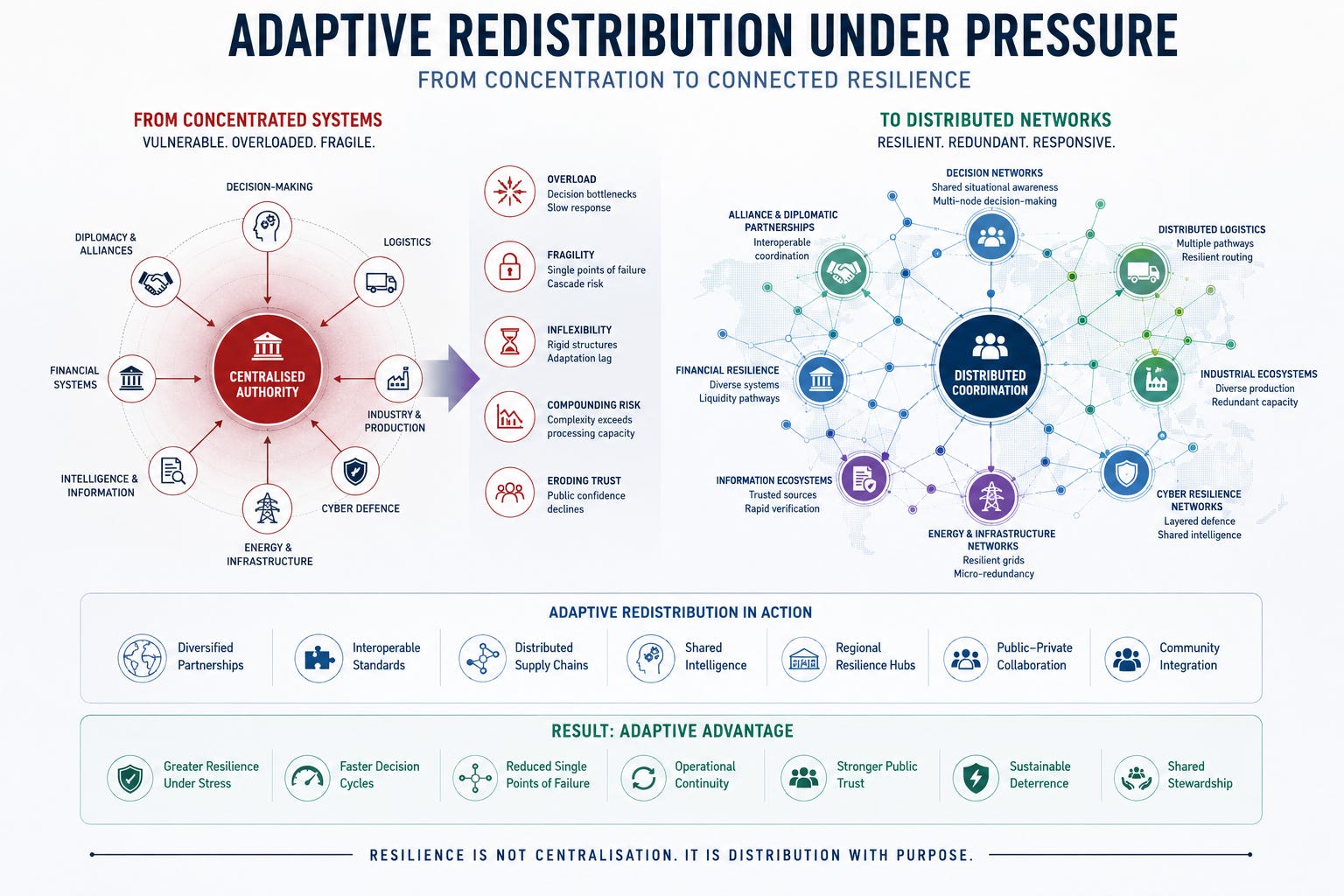
Under prolonged disruption, however, systems optimised primarily for efficiency can become surprisingly fragile once multiple forms of pressure begin arriving simultaneously.
The pandemic years exposed the fragility of overly concentrated supply chains.
Energy dependency became geopolitical vulnerability.
Semiconductor concentration became strategic risk.
Slow-moving bureaucratic systems increasingly struggled to respond at the speed of technological disruption and information acceleration.
The issue is not merely attack.
It is saturation.
Persistent complexity increasingly exceeds the processing capacity of rigid centralised systems.
Under prolonged strain:
information bottlenecks emerge,
institutional rigidity increases,
operational responsiveness slows,
and adaptation becomes delayed precisely when speed matters most.
This creates growing pressure toward more distributed forms of coordination capable of rerouting operational strain across broader networks rather than concentrating it inside singular institutional centres alone.
The issue is not that centralised institutions disappear.
They remain essential.
But concentrated systems increasingly require:
interoperable partnerships,
resilient sub-networks,
distributed support layers,
and continuity ecosystems
capable of absorbing complexity faster than singular centres can process alone.
The Spiderweb transition begins here.
Not through ideological revolution.
But through operational necessity.
III — Adaptive Sub-Networking
Under prolonged strain, democratic systems increasingly begin redistributing coordination across trusted operational clusters.
This is one of the defining behavioural characteristics of the Spiderweb transition.
Earlier Spiderweb essays explored how systems operating under pressure increasingly form adaptive sub-networks capable of redistributing operational strain across trusted coordination pathways.
What now becomes increasingly visible is that these behaviours are no longer theoretical.
They are increasingly observable across alliance systems, industrial ecosystems, cyber coordination networks, and democratic resilience structures already adapting under prolonged strategic pressure.
When central coordination slows, overloads, or destabilises, systems adapt by rerouting continuity across:
regional partnerships,
interoperability frameworks,
logistics ecosystems,
distributed industrial coordination,
and overlapping high-trust networks.
This is not fragmentation.
It is adaptive redistribution under pressure.
These adaptations rarely emerge cleanly or efficiently.
Most develop unevenly through improvisation, institutional friction, and operational necessity.
Much of this adaptation occurs not through grand redesign, but through systems improvising under pressure in real time.
The war in Ukraine accelerated many of these behaviours simultaneously.
NATO logistics systems became increasingly interoperable.
European industrial coordination expanded rapidly.
Drone innovation ecosystems emerged through distributed adaptation rather than singular centralised design.
Cyber defence increasingly depended upon layered coordination between governments, private industry, civilian technologists, and allied networks operating simultaneously.
Similar patterns are increasingly visible across:
Indo-Pacific minilateral partnerships,
Nordic preparedness systems,
sanctions coordination ecosystems,
and distributed continuity planning between democratic states facing persistent strategic pressure.
The web does not replace the centre.
It redistributes strain across the network.
This distinction is critical.
Because the Spiderweb Order is not anti-state.
Nor is it the dissolution of institutional authority.
Rather, it reflects the emergence of layered democratic coordination systems capable of preserving operational continuity under conditions where no singular actor can independently absorb systemic pressure across all domains simultaneously.
This marks the operational emergence of Spiderweb behaviour.
IV — Democratic Fatigue and Civic Endurance
The defining challenge of prolonged instability may ultimately become psychological and civilisational as much as operational.
The issue is not simply institutional endurance.
It is societal coherence under persistent uncertainty.
Across many democratic societies, populations increasingly exist inside environments defined by:
permanent information exposure,
outrage saturation,
political acceleration,
institutional distrust,
economic anxiety,
and continuous crisis consciousness.
People move from one controversy to the next without fully processing the previous one.
Elections become emotionally exhausting.
Public discourse fragments faster than institutions can stabilise it.
Algorithmic systems reward outrage, escalation, and emotional intensity while public trust erodes gradually through repetition rather than singular collapse.
Under these conditions, democratic societies increasingly face pressure toward:
cynicism,
disengagement,
hyper-polarisation,
social fragmentation,
and coercive simplification.
This is where the Spiderweb Order fundamentally differentiates itself from the Hybrid Order.
Hybrid environments increasingly reward:
manipulation,
distortion,
outrage amplification,
adversarial fragmentation,
and exhaustion politics.
Spiderweb adaptation instead increasingly depends upon:
participatory resilience,
distributed trust,
civic responsibility,
ethical stewardship,
and adaptive social cohesion.
The future survivability of democratic systems may therefore depend less upon authority alone and more upon whether societies retain the willingness to remain cooperative under persistent strain.
That may become one of the defining democratic challenges of the century ahead.
Informational Fragmentation and Extremist Acceleration
In many democracies, fragmentation increasingly behaves like a self-reinforcing ecosystem.
Distrust accelerates faster than institutions can repair it.
Outrage spreads faster than deliberation.
Algorithmic systems reward emotional escalation while adversarial actors exploit uncertainty, grievance, and exhaustion simultaneously.
Under prolonged strain, extremist ecosystems increasingly thrive not only because societies become radicalised, but because exhausted societies become vulnerable to simplification itself.
Modern extremist movements rarely remain confined to traditional ideological categories alone.
They increasingly operate through:
hybridised grievance narratives,
conspiratorial ecosystems,
anti-institutional mobilisation,
identity fragmentation,
emotionally amplified distrust,
and accelerationist rhetoric designed to intensify instability itself.
These environments are frequently exploited by adversarial actors engaged in informational warfare and systemic destabilisation campaigns.
National security agencies across multiple democratic states have increasingly identified extremist acceleration ecosystems and hybridised radicalisation environments as growing national security concerns capable of degrading:
institutional trust,
democratic legitimacy,
civic participation,
and social cohesion simultaneously.
The danger is not disagreement.
Democratic systems depend upon pluralism, dissent, and open political competition.
The danger emerges when fragmentation itself becomes structurally exploitable — degrading shared reality thresholds faster than democratic societies can absorb or stabilise them.
In Hybrid Order conditions, informational ecosystems increasingly become contested terrain.
The Spiderweb response therefore depends not upon suppressing democratic participation, but upon strengthening:
civic resilience,
informational literacy,
distributed trust networks,
ethical stewardship,
and participatory democratic coherence capable of resisting manipulation without collapsing into authoritarian consolidation.
V — Stewardship Under Conditions of Strain
No singular institution, government, or alliance can stabilise every domain simultaneously under conditions of continuous disruption.
This may become one of the defining realities of the emerging era.
As pressure accumulates across:
infrastructure,
logistics,
cyber systems,
economics,
alliances,
information ecosystems,
and civil society,
continuity increasingly becomes a shared responsibility.
Earlier essays within the Spiderweb framework increasingly argued that stewardship would become structurally necessary under conditions where no singular actor could independently stabilise all domains simultaneously.
Under prolonged strain, that transition increasingly appears visible across democratic systems adapting toward shared continuity responsibility.
This is where the ethical dimension of the Spiderweb Order becomes increasingly important.
Because stewardship under strain is not merely operational.
It is behavioural.
During periods of prolonged instability, democratic survivability increasingly depends upon ordinary forms of cooperation that rarely attract attention during stable periods:
communities maintaining social trust,
institutions preserving public credibility,
allied states sharing continuity burdens,
industries adapting under pressure,
citizens remaining civically engaged despite exhaustion,
and societies resisting the temptation to retreat entirely into cynicism or adversarial tribalism.
Stewardship therefore begins distributing across:
alliances,
middle powers,
institutions,
industry,
civil society,
local communities,
and interoperable continuity systems.
This is not decentralisation for its own sake.
Nor is it the abandonment of institutional authority.
It is layered democratic survivability.
Under contested conditions, resilience increasingly depends upon societies capable of:
sharing continuity burdens,
maintaining trust under pressure,
distributing adaptive capacity,
and preserving legitimacy without collapsing into authoritarian consolidation.
VI — The Adaptive Society
The future survivability of democratic systems may increasingly depend less upon restoring perfect stability and more upon developing adaptive culture.
Not merely:
military capacity,
economic scale,
or institutional complexity.
But:
behavioural flexibility,
resilience literacy,
continuity culture,
civic participation,
distributed responsibility,
and societal capacity to function under uncertainty.
Some democratic societies are already moving in this direction.
Nordic preparedness systems increasingly integrate civil society into national resilience planning.
Estonia’s cyber resilience culture emerged directly from sustained pressure and vulnerability.
Ukraine’s wartime adaptation demonstrated how distributed civic participation, improvisation, and operational flexibility can preserve continuity under extraordinary strain.
These examples matter because they demonstrate something increasingly important:
adaptive resilience is not solely institutional.
It is cultural.
Adaptation under prolonged instability is not purely institutional.
Over time it also becomes behavioural.
Societies gradually learn which forms of cooperation preserve continuity and which forms of fragmentation accelerate exhaustion.
The culture itself begins adjusting to the environment.
Over time, resilience becomes less about temporary recovery and more about the preservation of social coherence under conditions where uncertainty itself becomes normalised.
The issue is no longer:
how societies return to equilibrium.
It is:
how societies remain operationally coherent while instability persists.
This may ultimately become the defining civilisational transition of the Hybrid era.
The Spiderweb Order therefore represents more than strategic architecture alone.
It increasingly represents the gradual evolution of democratic civilisation toward:
adaptive continuity,
distributed resilience,
participatory stewardship,
and cooperative survivability under persistent strain.
The Hybrid Order creates the condition.
The Spiderweb Order emerges as the democratic adaptation to that condition.
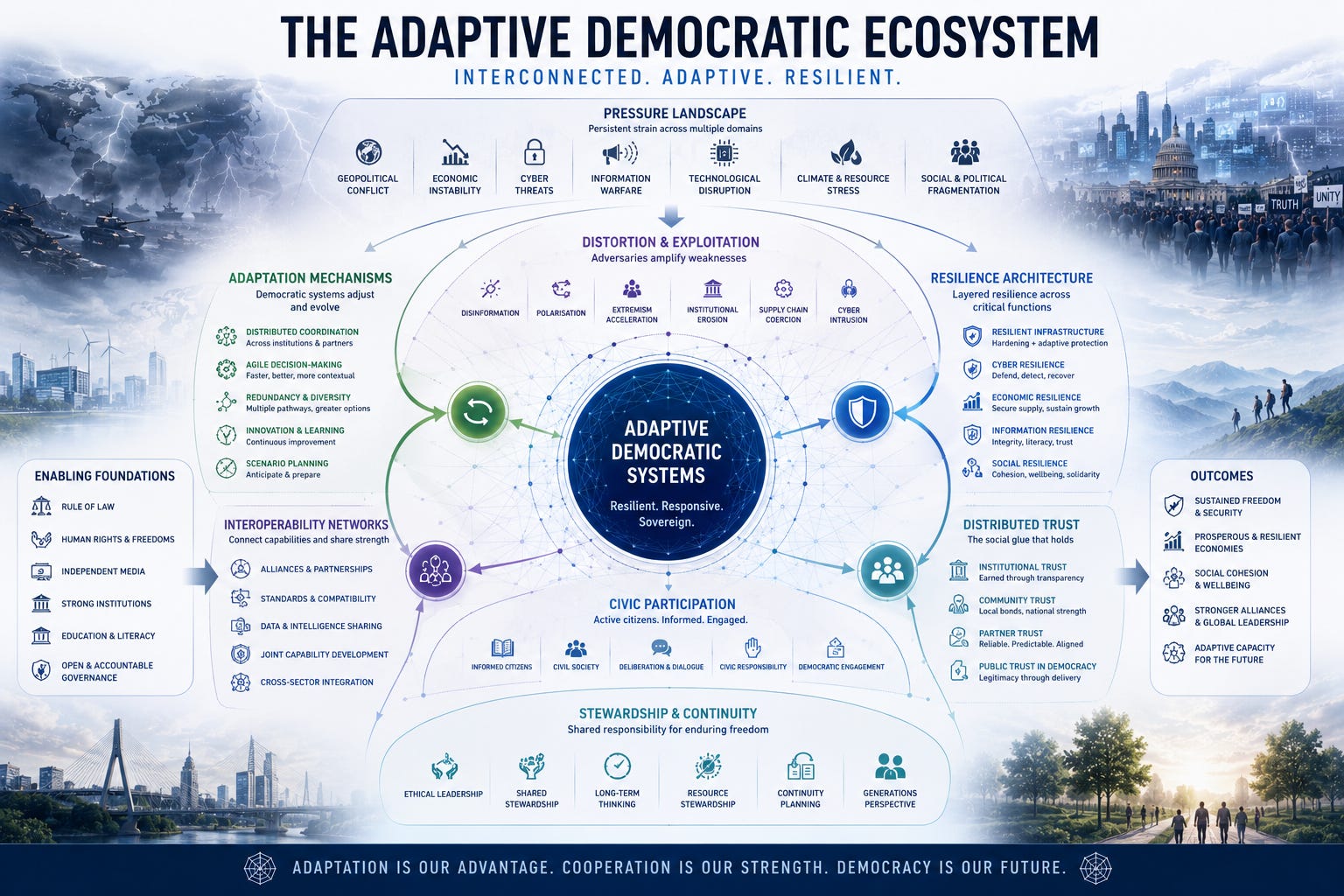
VII — The Spiderweb Transition
The Spiderweb Order does not emerge because societies consciously design a perfect networked future.
Across earlier essays, the Spiderweb Order often appeared through fragments:
resilience systems,
distributed coordination,
adaptive sub-networking,
stewardship pathways,
continuity architecture,
and layered interoperability.
Under prolonged instability, these mechanisms increasingly converge into a broader democratic adaptation model capable of operating inside Hybrid Order conditions.
Persistent instability increasingly rewards systems capable of:
distributed adaptation,
layered resilience,
participatory continuity,
operational flexibility,
interoperability,
civic endurance,
and adaptive democratic coherence.
Many of these transitions are already visible.
States increasingly diversify continuity pathways.
Alliances increasingly distribute operational burdens.
Societies increasingly reconsider the relationship between efficiency and resilience.
Communities increasingly adapt to operating under ambient uncertainty rather than temporary disruption alone.
This transition remains:
incomplete,
uneven,
contested,
and continuously pressured.
But the trajectory increasingly reflects a broader civilisational shift:
from:
stability through concentration
toward:
survivability through adaptive distribution.
The Spiderweb Order therefore represents:
not the abandonment of democratic systems under strain,
but their evolutionary adaptation to survive it.
Conclusion
Adaptation Becomes Permanent
The age of temporary disruption may be ending.
Democratic societies increasingly adapt:
not toward stable equilibrium,
but toward continuous operational adjustment inside contested environments.
The societies most capable of enduring the decades ahead may not necessarily be those capable of eliminating instability altogether.
They may instead be the societies capable of remaining:
adaptive,
cooperative,
operational,
participatory,
and socially coherent
while pressure itself becomes permanent.
In this sense, the Spiderweb Order is not a promise of perfect stability.
It is the gradual democratic adaptation to a world where resilience, stewardship, participation, and continuity increasingly become shared responsibilities carried across societies, institutions, alliances, and communities during periods where stability itself can no longer be assumed.