

Resilience Architecture
Building Capacity Across Distributed Networks

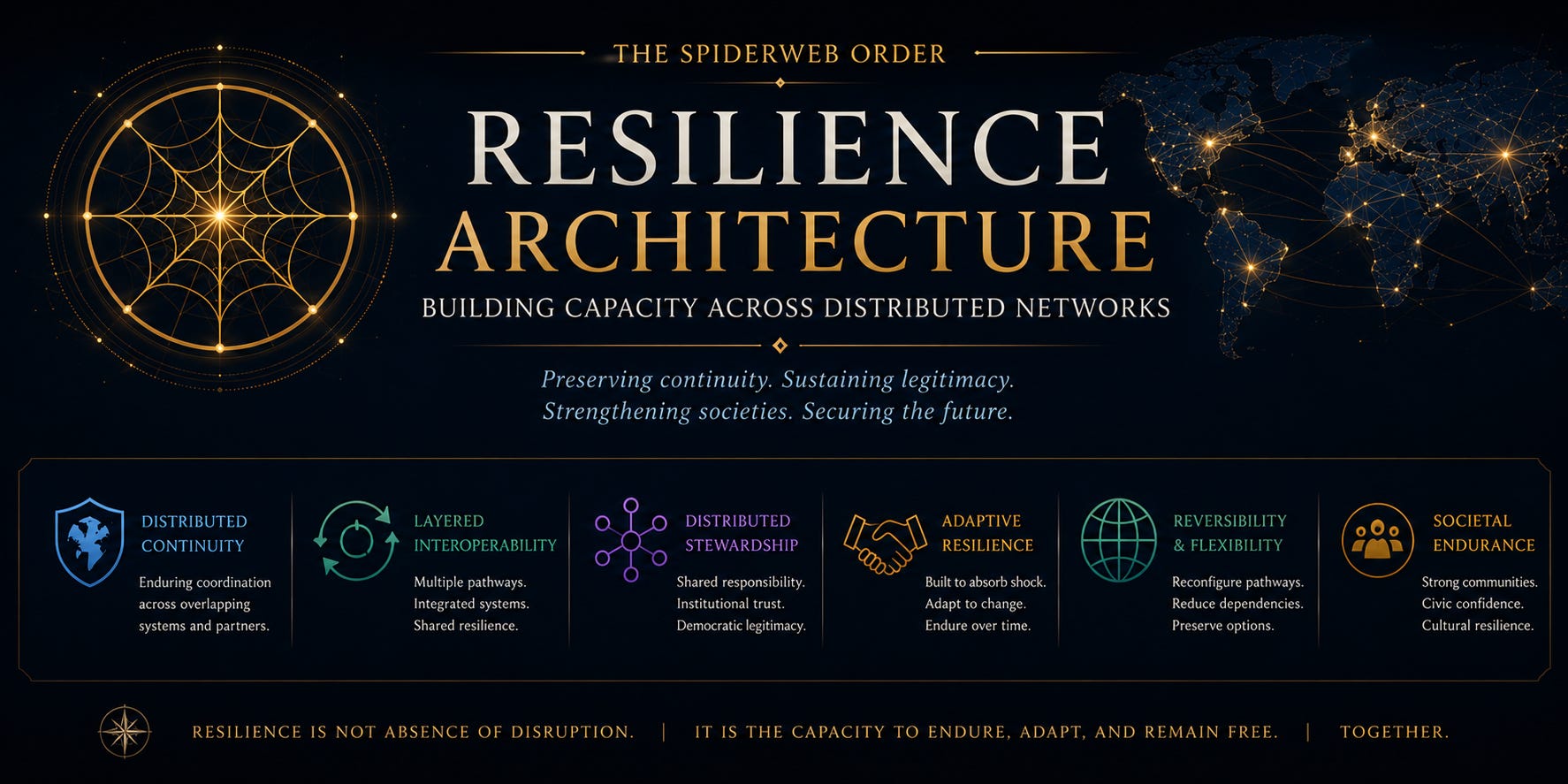
How democratic resilience systems preserve survivability under prolonged instability.
The defining challenge of the emerging era is not simply whether systems can adapt under pressure.
It is whether democratic societies can preserve legitimacy, participation, sovereignty, and operational function while adapting fast enough to survive persistent instability.
The Spiderweb Order does not attempt to eliminate instability from the international system.
It attempts to preserve democratic continuity within it.
In increasingly hybridised geopolitical conditions, resilience may depend less upon singular centres of control and more upon the ability of societies, institutions, alliances, and communities to preserve coordination, legitimacy, and adaptive endurance without requiring coercive centralisation.
INTRODUCTION
Continuity Under Pressure
Modern democratic systems increasingly operate under conditions of overlapping disruption.
Economic instability, geopolitical rivalry, technological competition, institutional distrust, information fragmentation, and social exhaustion increasingly interact simultaneously rather than independently.
Under these conditions, resilience becomes more than preparedness.
It becomes the ability to preserve operational function without surrendering legitimacy.
For decades, many democratic systems operated under assumptions shaped by relative geopolitical stability:
concentrated efficiency
procedural coordination
institutional predictability
centralised operational systems
These models generated extraordinary capability and prosperity under stable conditions.
But prolonged instability increasingly exposes the vulnerabilities embedded inside highly concentrated systems.
Coordination slows.
Institutions become overloaded.
Dependencies harden into constraints.
Public trust erodes under repeated strain.
The defining question therefore shifts.
Not:
how systems prevent disruption entirely.
But:
how democratic societies preserve legitimacy, participation, and societal endurance while disruption itself becomes persistent.
This tension becomes increasingly important because adaptation alone does not automatically favour democratic systems.
Authoritarian systems may also adapt effectively through:
concentration
coercion
accelerated centralisation
information control
The emerging Hybrid Order therefore does not describe a democratic future by default.
It describes an increasingly fragmented, overlapping, and adaptive international environment emerging under prolonged geopolitical, technological, economic, and institutional strain.
The Spiderweb Order does not describe the entirety of this emerging environment.
It describes one possible democratic resilience architecture capable of operating within it.
I — The Limits of Concentrated Stability
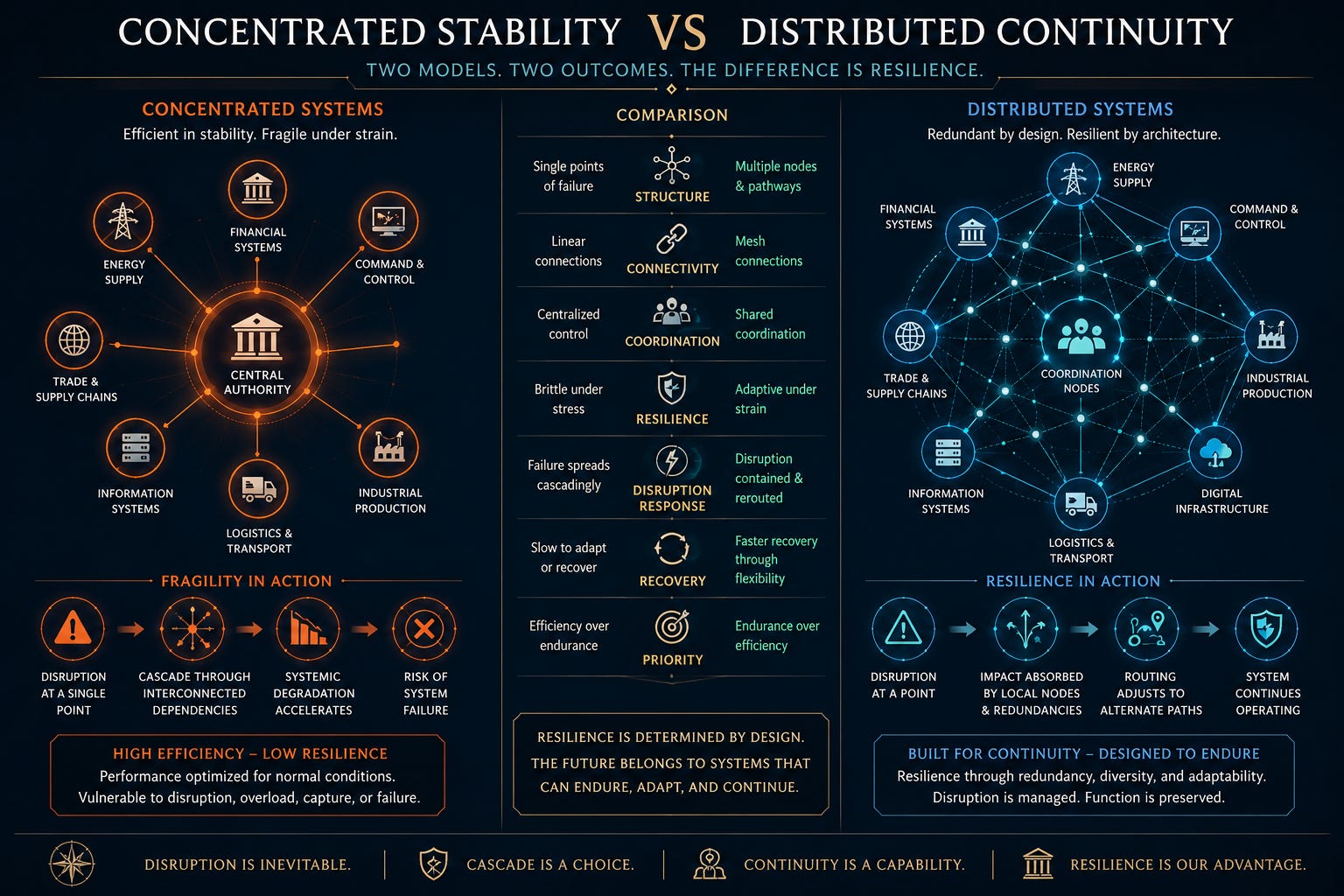
For decades, global systems prioritised:
efficiency
scale
optimisation
concentration
procedural centralisation
Under stable conditions, these systems often generated extraordinary capability.
But under prolonged instability, concentrated systems increasingly struggle with:
coordination bottlenecks
dependency concentration
institutional overload
strategic rigidity
cascading disruption
legitimacy strain
Highly optimised systems maximise efficiency under stable conditions.
Resilient systems prioritise survivability under unstable conditions.
This distinction increasingly defines the emerging era.
The challenge is not concentration itself.
Complex societies require:
expertise
coordination hubs
institutional anchors
specialised capability centres
The problem emerges when operational function depends too heavily upon singular pathways vulnerable to overload, disruption, capture, or paralysis.
Under adaptive geopolitical conditions, resilience increasingly depends upon the ability to:
reroute
redistribute
absorb disruption
preserve coordination across multiple pathways simultaneously
Resilience therefore becomes less about preventing pressure entirely and more about preserving societal function despite pressure.
II — Continuity Systems and Layered Interoperability
Resilience does not mean invulnerability.
Nor does it imply permanent stability.
Instead, resilient systems preserve:
coordination
legitimacy
operational function
societal confidence
adaptability
despite disruption.
This increasingly requires layered interoperability.
No singular institution independently preserves stability across all domains simultaneously.
Modern survivability increasingly emerges through overlapping systems of:
alliances
industrial networks
logistics systems
legal frameworks
energy coordination
digital infrastructure
financial systems
information validation networks
These layers reinforce one another operationally.
If one node weakens, others compensate.
If one pathway destabilises, coordination reroutes through alternative channels.
The objective is not redundancy for its own sake.
It is preserving enough flexibility that disruption in one domain does not automatically produce systemic paralysis.
Resilience therefore depends less upon eliminating disruption entirely and more upon preserving the ability to adapt while systems remain under strain.
This is one of the defining distinctions between rigid systems and resilient systems.
Rigid systems often fail abruptly once pressure exceeds central tolerance thresholds.
Layered systems degrade more gradually while preserving coordination capacity.
NATO Interoperability During Ukraine
The war in Ukraine demonstrated this logic operationally.
The resilience of the Western response did not emerge solely from military capability.
It emerged through interoperability:
intelligence sharing
logistics coordination
sanctions integration
industrial alignment
distributed sustainment
financial coordination
technological cooperation
No singular actor independently carried the entire burden of survivability.
The wider network preserved operational coordination collectively.
This did not eliminate friction or disagreement.
But layered interoperability prevented disruption from collapsing coordination entirely.
That distinction is increasingly important under prolonged instability.
III — Democratic Continuity and Distributed Stewardship
The Spiderweb Order is not resilient because it concentrates authority more effectively.
It is resilient because it distributes stabilisation responsibility broadly enough that democratic participation, sovereignty, and adaptive capacity survive under strain.
This is distributed democratic stewardship.
Stewardship is not charity.
Nor is it idealistic moralism detached from strategic reality.
It emerges structurally because stability itself becomes mutually reinforcing under conditions where no singular actor can independently preserve societal function across every domain simultaneously.
Layered resilience systems improve strategic flexibility while reducing the vulnerability created by excessive concentration.
Under conditions where no singular state can independently preserve stability across all domains simultaneously, operational resilience increasingly becomes a shared responsibility distributed across interoperable actors.
This does not eliminate asymmetry.
Larger powers retain disproportionate capability.
Yet under prolonged instability, even highly capable states increasingly depend upon trusted networks capable of sharing stabilisation burdens across multiple domains simultaneously.
Interoperability, reversibility, and institutional trust therefore become increasingly important resilience functions rather than secondary administrative concerns.
Stewardship increasingly becomes operational rather than symbolic under conditions of distributed strain.
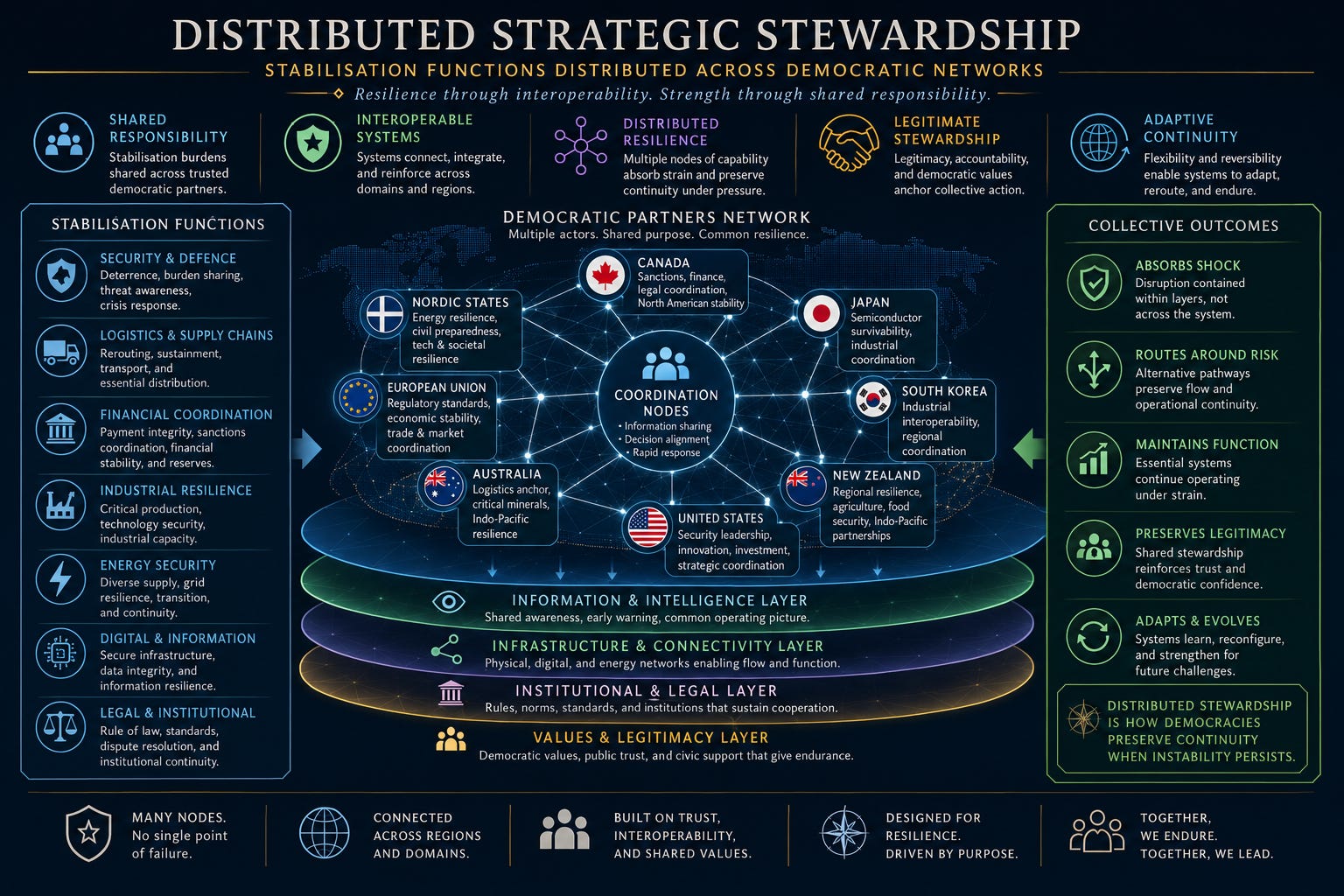
These stabilisation functions increasingly distribute across multiple democratic actors rather than remaining concentrated solely within singular centres of power.
Under fragmented strategic conditions, middle powers increasingly contribute stabilisation functions that preserve coordination across the wider network.
Canada contributes:
sanctions coordination
financial interoperability
legal-regulatory synchronisation
stabilisation across North American systems
Australia increasingly functions as:
a logistics anchor
critical minerals stabiliser
Indo-Pacific resilience partner
energy transition node
Nordic states reinforce:
energy resilience
civil preparedness
technological coordination
societal resilience systems
Japan and South Korea continue strengthening:
semiconductor survivability
industrial interoperability
regional coordination ecosystems
These states are not replacing larger powers.
Capability remains differentiated.
But stabilisation responsibilities become more broadly distributed across interoperable systems capable of preserving coordination under strain.
This distinction matters profoundly.
Authoritarian systems may preserve stability through coercive concentration.
Democratic resilience increasingly depends upon societies broadening participation in stability itself.
IV — Societal Continuity
Democratic resilience ultimately depends upon more than institutional architecture alone.
It depends upon whether societies themselves remain resilient under prolonged instability.
This may become one of the defining differences between democratic resilience systems and coercive stability systems.
Authoritarian systems may preserve order through:
fear
surveillance
centralised control
informational restriction
Democratic systems rely more heavily upon:
trust
participation
legitimacy
civic responsibility
institutional confidence
ethical responsibility
This makes democratic resilience simultaneously stronger and more fragile.
Stronger because participation broadens adaptability across society.
More fragile because democratic confidence must continually be maintained rather than imposed.
The resilience of democratic systems therefore depends not solely upon governments or institutions, but upon whether citizens continue remaining invested in shared civic life despite uncertainty, exhaustion, or frustration.
This includes:
public trust
community preparedness
information integrity
civic participation
local resilience
institutional accountability
ethical stewardship
Resilience increasingly becomes cultural as much as institutional.
Finnish Societal Preparedness
Finland provides one example of this logic.
Its resilience architecture extends far beyond military capability alone.
Preparedness is distributed socially across:
institutions
infrastructure
education systems
local communities
emergency planning
civic participation
Resilience becomes embedded culturally rather than imposed hierarchically.
Finland is not important because it offers a perfect model.
It is important because it demonstrates how resilience strengthens when responsibility for societal endurance extends broadly across society rather than remaining confined solely to central institutions.
V — Reversibility and Anti-Capture Systems
Resilient systems must preserve adaptability without allowing operational systems themselves to become captured by:
monopolisation
dependency lock-in
coercive leverage
institutional rigidity
strategic overconcentration
This is why reversibility becomes increasingly important under fragmented strategic conditions.
Systems unable to shift suppliers, alliances, financial pathways, or industrial coordination under pressure often become strategically rigid long before they collapse outright.
Resilient systems retain the ability to:
reroute coordination
diversify dependencies
redistribute stabilisation functions
shift coordination pathways
reconfigure strategic relationships under pressure
Systems capable of shifting supply chains, financial pathways, industrial coordination, or alliance structures under stress retain greater strategic flexibility than systems locked into rigid dependency structures.
Reversibility does not eliminate complexity.
It preserves flexibility inside complexity.
This applies across:
logistics systems
financial coordination
industrial ecosystems
alliance structures
technological standards
energy networks
Rigid systems often fracture once disruption exceeds the tolerance capacity of centralised structures.
Layered resilience systems preserve survivability by maintaining enough flexibility to adapt before disruption becomes catastrophic.
This is one reason layered resilience systems increasingly outperform rigid concentration models under prolonged instability.
VI — Fragility Inside Distributed Systems
The Spiderweb Order is not self-stabilising.
Distributed systems remain vulnerable to:
institutional trust erosion
civic exhaustion
coordination overload
public distrust
information fragmentation
institutional fatigue
fragmented incentives
overcomplexity
elite disengagement
Complexity itself may become destabilising if coordination burdens exceed institutional or civic capacity.
Distributed systems may also fail if:
stewardship incentives weaken
interoperability deteriorates
public trust collapses
societies retreat into fragmentation faster than resilience systems can adapt
Democratic resilience therefore requires continual renewal.
Not static preservation.
This may become one of the defining tensions of the emerging era.
Authoritarian systems often simplify coordination through coercive compression.
Democratic systems must preserve adaptability while retaining legitimacy simultaneously.
That balance is difficult.
And it cannot be permanently solved.
Only continually maintained.
VII — The Resilient Society
The Spiderweb Order does not promise permanent stability.
Nor does it eliminate competition, disruption, or geopolitical rivalry.
Instead, it explores how democratic societies preserve societal endurance without abandoning the principles that made resilience worth preserving in the first place.
The defining challenge of the emerging era may not be preventing instability entirely.
It may be preserving democratic function and social cohesion while instability itself becomes persistent.
The future may therefore belong not solely to the most efficient systems under ideal conditions.
It may increasingly belong to societies capable of distributing resilience broadly enough that disruption does not automatically produce collapse, coercive centralisation, or democratic exhaustion.
Resilient systems are not systems that never experience disruption.
They are systems capable of preserving institutional trust, adaptability, and societal function even when disruption becomes enduring rather than exceptional.
The Spiderweb Order does not seek perfect stability.
It seeks societies capable of remaining legitimate, adaptive, and connected even when stability itself can no longer be assumed.
In this sense, resilience becomes more than strategy alone.
It becomes the collective willingness of societies to remain connected, adaptable, and responsible to one another during periods where certainty itself can no longer be guaranteed.