

Is Autonomy an Illusion?
Strategic sovereignty in an age of continuous influence

We often speak of autonomy as though it were a stable possession — a sovereign attribute safeguarded by constitutions, elections, and civic norms.
But in an era of pervasive narrative warfare, influence operations below the threshold of open conflict, and structural incentives that reward manipulation, autonomy demands interrogation:
Is autonomy inherent — or is it perpetually contested?
If autonomy is shaped by forces we neither fully observe nor fully control, then perhaps autonomy is less a possession than a field of strategic contention that must be continually defended.
Narrative as Strategic Terrain
Ukraine’s Ambassador to Australia, His Excellency Vasyl Myroshnychenko, captured a fundamental shift in strategic competition:
“In a post‑truth world, the contest is not in the boardroom, not on the battlefield — the contest is in the public perception of reality.”
This is not rhetorical flourish; it is a description of how influence now operates. When perception is the principal field of conflict, autonomy becomes vulnerable not merely to force, but to the informational environment in which judgements are formed.
Autonomy presumes informed agency.
Informed agency requires an informational environment that is coherent, accessible, and reliable.
When that environment is systematically shaped by strategic actors — both domestic and foreign — autonomy becomes a contested variable rather than an inherent right.
Russia’s Strategic Proximity and Regional Influence
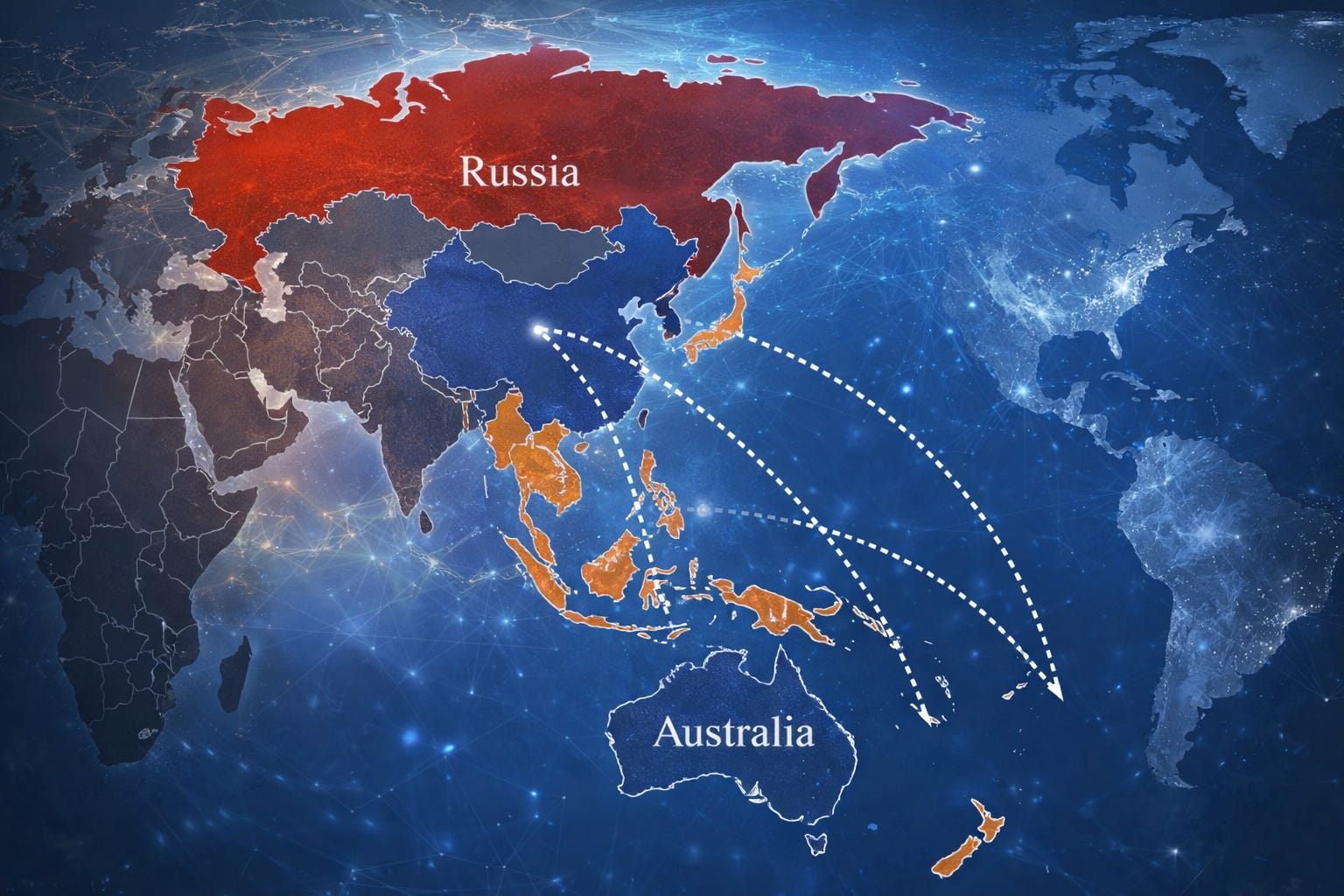
Ambassador Myroshnychenko emphasised the regional dimensions of strategic influence — an insight that matters profoundly for Australian strategic thinking. According to the Lowy Institute’s Asia Power Index 2025, Russia now ranks 5th out of 27 countries in the Asia-Pacific for comprehensive power, overtaking Australia and placing it ahead of numerous middle powers in the region.
“Russia’s footprint is not just a distant concern — it is regionally proximate, structurally embedded, and strategically consequential.”
This ranking reflects Russia’s combined capabilities across military strength, resilience, economic capacity, diplomatic influence, and networked power — even as Western sanctions and the war in Ukraine impose costs. Australia, by contrast, now ranks 6th in the same index.
This matters because it shows that Russia’s footprint — whether through diplomatic engagement, defence networks, or resilient capacity — is relevant not only in Eastern Europe but in the broader strategic environment that includes Southeast Asia and the Indo-Pacific at large. If autonomy is to be defended, the fact that a major authoritarian actor ranks comparably to regional middle powers — and ahead of Australia — underscores that strategic pressure is not geographically remote but regionally proximate.
Foreign Interference and Espionage: Australia’s Structural Reality

Australia’s domestic intelligence leadership has made clear that foreign states are actively seeking strategic advantage through influence operations and espionage.
In the Annual Threat Assessment 2025, ASIO Director-General Mike Burgess warned that Australia is in:
“a period of strategic surprise and security fragility, many of the foundations that have underpinned Australia’s security, prosperity and democracy … are being tested.”
Among these foundational pressures, ASIO identified that a hyper‑connected world allows political tensions and conflicts overseas to resonate quickly in Australia, spread by social media and online echo chambers, inflamed by mis‑ and disinformation.
Further, Australia’s security community has publicly disclosed that 24 significant espionage and foreign interference operations have been disrupted in the last three years — more than in the previous eight years combined. These operations have targeted not only defence and research sectors, but also civil society and diaspora networks, illustrating an ongoing, multi‑vector campaign to shape information environments and political decision spaces.
This is not speculative — it is official and continuous.
G7 Recognition of Systemic Information Manipulation

Australia’s concerns are shared by like‑minded partners. The G7 Rapid Response Mechanism has formally determined that Russia has:
“funded and directed covert efforts … to subvert societies using global disinformation and influence campaigns.”
These campaigns aim to exploit social and political issues, polarise communities, and undermine confidence in democratically elected institutions and processes.
This multilateral acknowledgement underscores that foreign information manipulation and interference (FIMI) is not an incidental tactical problem — it is a strategic, ongoing, and systemic challenge to the conditions under which autonomous judgement can form.
Domestic Vulnerabilities: The Incentive Architecture of Influence
Foreign pressures exploit vulnerabilities that democracies themselves already possess. These domestic structural features include:
Financial influence shaping access, policy priorities, and considered judgement;
Media and social platforms that amplify content based on engagement incentives rather than truth or strategic coherence;
Reputational aggression — including strategic character attacks — used to shape public opinion and fracture shared understanding.
These mechanisms are not fringe; they are systemic features of open societies that shape what is seen, what is heard, and what is believed.
Foreign actors need not override democratic systems to influence them. They only need to operate within existing structures of influence, leveraging polarisation, informational dislocation, and strategic ambiguity to shape outcomes.
In this sense, autonomy is contested on two converging fronts:
External: deliberate influence operations by foreign powers seeking strategic advantage;
Internal: domestic incentive structures that reward strategic narrative shaping and reputational competition.
Together, these pressures constrain autonomy not by force, but by shaping the conditions of judgement itself.
The Information Environment and Strategic Autonomy
If the environment in which choices are made is systematically shaped by actors with strategic agendas, then autonomy ceases to be a simple default. It becomes a function of clarity of environment, resilience of institutions, and collective attention to how information influences judgment.
When misinformation, disinformation, and algorithmic amplification distort the public sphere, autonomous judgement is not erased — it is diluted and commandeered by competing pressures.
This is not abstraction. It is tactical reality, as Ambassador Myroshnychenko’s observation about narrative power underscores.

A Strategic Response: Middle Power Democratic Compact
If autonomy is structurally contested, defending it requires systemic reinforcement, not merely rhetorical affirmation.
Ambassador Myroshnychenko has urged middle powers to act together — not just on shared values, but to maintain the conditions that make autonomous agency possible. How might that work in practice?
Coordinated Information Resilience
Joint early warning systems for influence operations;
Shared public attribution mechanisms;
Collaborative investment in digital literacy and platform transparency.
Cooperative Economic De‑Risking
Diversification of critical supply chains;
Strategic collaboration on cyber and industrial defence;
Frameworks to resist economic coercion that skews domestic policy.
Unified Norm Reinforcement
Coordinated stances in multilateral forums on sovereignty and narrative integrity;
Collective sanctions responses to repeated interference;
Mutual defence of electoral and informational spheres.
This is not a military alliance. It is a sovereignty reinforcement network — an architecture that defends autonomy not by force, but by strengthening the environments in which autonomous judgement can be exercised.
Autonomy as Practice, Not Possession
To ask whether autonomy is an illusion is not to deny its value. It is to recognise its structural fragility.
Autonomy exists not as freedom from influence, but as the capacity to choose with clarity in the presence of conflicting pressures. It is enacted continuously, within contested informational, economic, and normative environments shaped by both domestic and foreign actors.
Autonomy is not erased by these pressures.
But it is constrained by them.
Conclusion: The Contested Terrain of Autonomy
Is autonomy an illusion?
No — but it is not immutable.
It is not assured by constitutions alone.
It is not guaranteed by elections.
It is not protected by good intent.
Autonomy is a condition of disciplined resilience, continually calibrated against internal incentives and external pressures.
If narrative is battlefield, clarity becomes strategy.
If influence is currency, integrity becomes defence.
If autonomy is contested on multiple fronts, it becomes a practice, not a birthright.
The illusion would not be autonomy itself —
but believing it requires no maintenance.
