
Finding True North

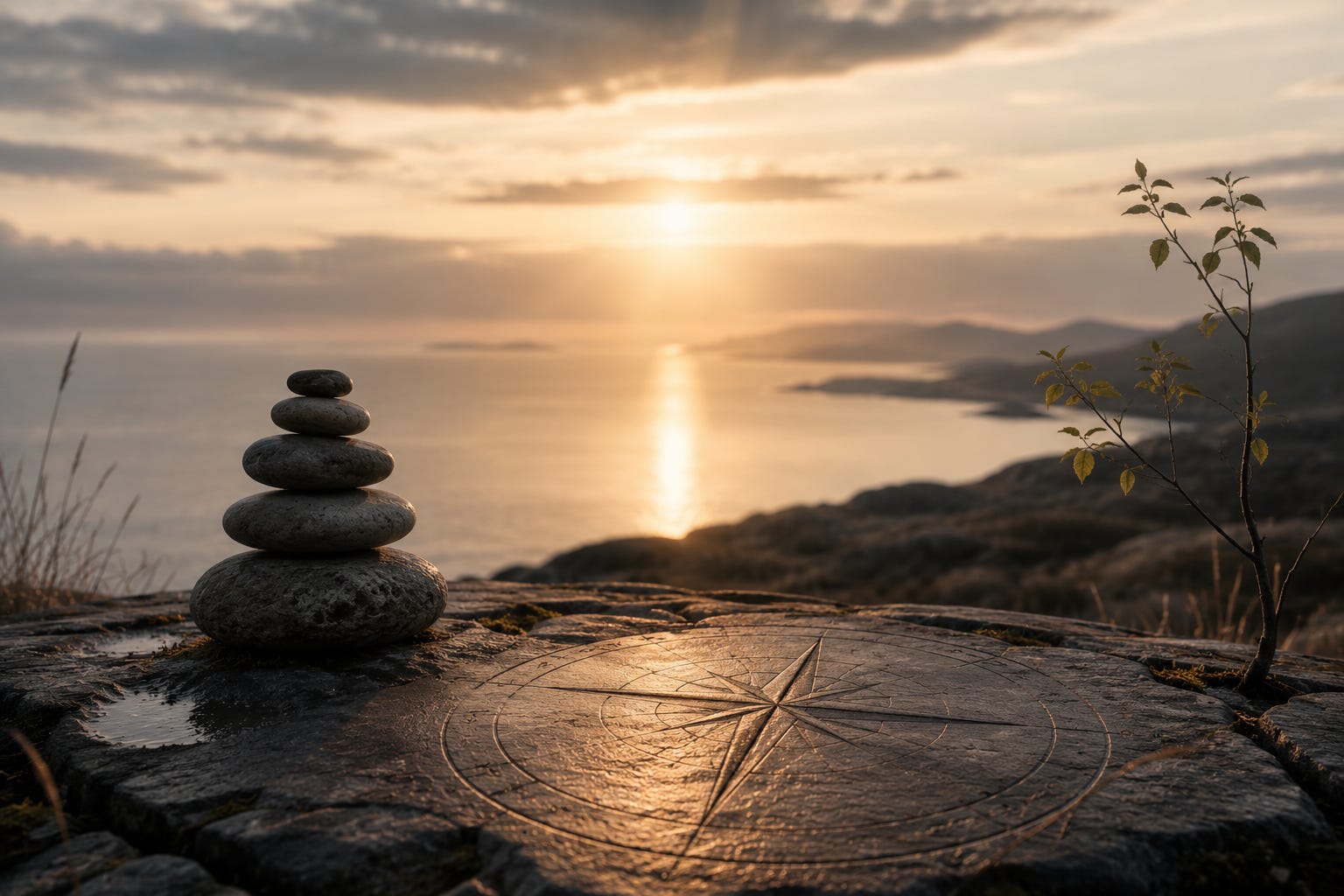
I’ve always liked compasses.
I’m not sure why.
Perhaps it’s because they’re so unassuming.
For all their importance, they’re remarkably modest little objects.
They don’t demand our attention.
They don’t tell us where we should go.
They don’t make decisions for us.
They don’t promise certainty.
They simply accompany the traveller.
Long before maps were carefully drawn or compasses carried aboard ships, there were the stars. Travellers lifted their eyes to the night sky, learning to recognise patterns that remained constant while everything around them changed. The landscape shifted. Storms came and went. Seasons turned. Yet above them remained fixed points by which they could quietly orient themselves.
The invention of the compass didn’t replace the stars.
It simply allowed humanity to carry that same search for orientation in the palm of a hand.
There’s something quietly beautiful about that.
What fascinates me isn’t that a compass points north.
It’s what happens before it does.
It’s interesting watching the needle.
It doesn’t rush.
It moves.
Then it settles.
Only then does it point.
The thing that strikes me is that the world around it hasn’t changed at all.
The landscape is still unfamiliar.
The path ahead remains uncertain.
The needle simply found its bearing first.
A compass doesn’t choose our path.
It can’t tell us which mountain to climb, which river to cross or which destination to pursue.
It simply helps us recognise where we are before we decide where to go.
I wonder whether we’ve been searching for something similar all along—not just in the landscape, but in life itself.
I wonder whether that’s why the idea of a compass has stayed with us for so long.
Not because it tells us where to go.
But because it reminds us that finding our way is rarely a single decision.
It’s something we keep returning to.
I suspect most of us don’t lose our way all at once.
Life rarely works that way.
More often, we hardly notice it’s happening.
One compromise.
One distraction.
A resentment we hold onto.
An ambition we stop questioning.
One decision we convince ourselves doesn’t really matter.
Taken on their own, none of those things seem particularly significant.
Yet, over time, they can quietly pull us further away from the person we hoped to become.
I’ve been wondering whether that’s one of the challenges of modern life.
Not simply that there are so many things competing for our attention.
But that there are so many things quietly shaping the direction of our lives.
Lately, I’ve found myself thinking about noise.
Not noise in the ordinary sense.
Something quieter than that.
The thoughts, expectations, assumptions and demands that slowly crowd out the space where reflection once lived.
Perhaps noise is anything that makes it difficult to hear what is quietly true.
Perhaps the greatest challenge of our age is not learning how to speak.
It is learning how to hear our own conscience beneath the noise.
Conscience rarely shouts.
It doesn’t compete for attention.
It doesn’t flatter us.
It doesn’t promise quick rewards.
More often, it asks uncomfortable questions.
It invites us to pause when we would rather react.
To reflect when we would rather judge.
To reconsider when certainty feels easier.
Learning to listen to our conscience requires practice.
Not because the voice itself is weak.
But because so much else speaks before it.
So how do we become better at hearing that quiet voice?
I’ve come to think it begins with ordinary moments.
By creating moments of quiet before reacting.
By becoming curious before becoming certain.
By reading deeply instead of simply reading constantly.
By choosing conversations that challenge us rather than simply confirming what we already believe.
By admitting, from time to time, that we might be wrong.
None of these things are particularly impressive.
In fact, most are easily overlooked.
They won’t attract attention.
Most are invisible to everyone except ourselves.
Yet, I wonder whether they’re the quiet habits from which character is formed.
Conscience isn’t something we discover once and possess forever.
It’s something we strengthen—or neglect—through the ordinary choices we make every day.
A compass doesn’t promise certainty.
Before we decide where the world is going... perhaps we should ask whether we still know which way is north.
Not only as nations.
Not only as communities.
But as individuals.
Integrity begins within.
The compass doesn’t walk the path for us.
Neither does conscience.
Both help us recognise our bearing before we take the next step.