

Distributed Order Under Pressure
How polycrisis is forcing the reorganisation of democratic coordination

INTRODUCTION — THE SYSTEM IS ALREADY ADAPTING
The international system is no longer experiencing isolated crises.
It is entering an era in which war, economic coercion, cyber disruption, political fragmentation, industrial competition, and information conflict increasingly overlap inside the same operational environment.
The international system is beginning to reorganise itself under strain.
Not through treaty.
Not through institutional redesign.
And not through the deliberate construction of a new global order.
The transition toward distributed order is not being driven by ideology alone, but by the inability of increasingly concentrated systems to absorb simultaneous stress across multiple domains.
For decades, democratic coordination depended heavily on four interconnected assumptions:
crises would emerge sequentially rather than simultaneously
strategic stability could be anchored through concentrated leadership
institutional consensus could operate at sufficient speed to manage escalation
efficiency and optimisation would strengthen resilience
Under conditions of strategic compression, those assumptions increasingly produce fragility instead.
War now intersects directly with energy systems, industrial capacity, information ecosystems, cyber infrastructure, migration pressure, financial stability, and domestic political cohesion simultaneously. Supply chains have become strategic terrain. Economic interdependence has become a vector for coercion. Information systems now shape operational environments before formal escalation even occurs.
The result is not simply instability.
It is overlap.
The war in Ukraine revealed this transition with unusual clarity.
What began as a territorial invasion rapidly evolved into:
an energy crisis
a sanctions war
an industrial mobilisation challenge
a supply-chain disruption
a financial confrontation
an information conflict
a test of democratic cohesion
a stress test of alliance coordination itself
The response was equally revealing.
Coordination increasingly emerged not only through traditional institutional pathways, but through coalition groupings, distributed production systems, intelligence-sharing arrangements, regional partnerships, sanctions mechanisms, industrial coordination structures, and strategic alignments operating simultaneously across multiple domains.
The significance of this shift lies not only in what these systems did.
It lies in why they emerged.
The existing order is not collapsing outright.
But under conditions of sustained multi-domain strain, singular coordination systems increasingly struggle to adapt fast enough across multiple simultaneous fronts.
States are responding accordingly.
The transition toward distributed order has already begun.
I — THE COLLAPSE OF COORDINATION ASSUMPTIONS
The post-Cold War order was built upon conditions that no longer reliably exist.
Its institutions and coordination systems emerged during an era in which:
crises could largely be compartmentalised
escalation timelines were slower
economic interdependence was treated primarily as stabilising
institutional legitimacy could be maintained through procedural consensus
concentrated leadership structures remained broadly trusted
These assumptions were not irrational.
Under relatively stable conditions, they worked.
But modern environments shaped by simultaneity and compression increasingly punish the very forms of concentration that once produced stability.
The assumption of sequential crisis management has weakened first.
The previous order largely assumed that financial crises, regional wars, energy instability, cyber disruption, technological competition, and domestic political fragmentation could be managed independently.
That separation is eroding rapidly.
The war in Ukraine demonstrated how quickly disruption now propagates across systems. Energy markets destabilised almost immediately. Food supply chains were disrupted globally. Sanctions generated secondary industrial and financial effects across multiple regions simultaneously. Information warfare unfolded continuously alongside battlefield operations. Cyber activity, infrastructure vulnerability, inflationary pressure, migration flows, and industrial capacity constraints all intersected within the same strategic environment.
Pressure no longer accumulates linearly.
It converges.
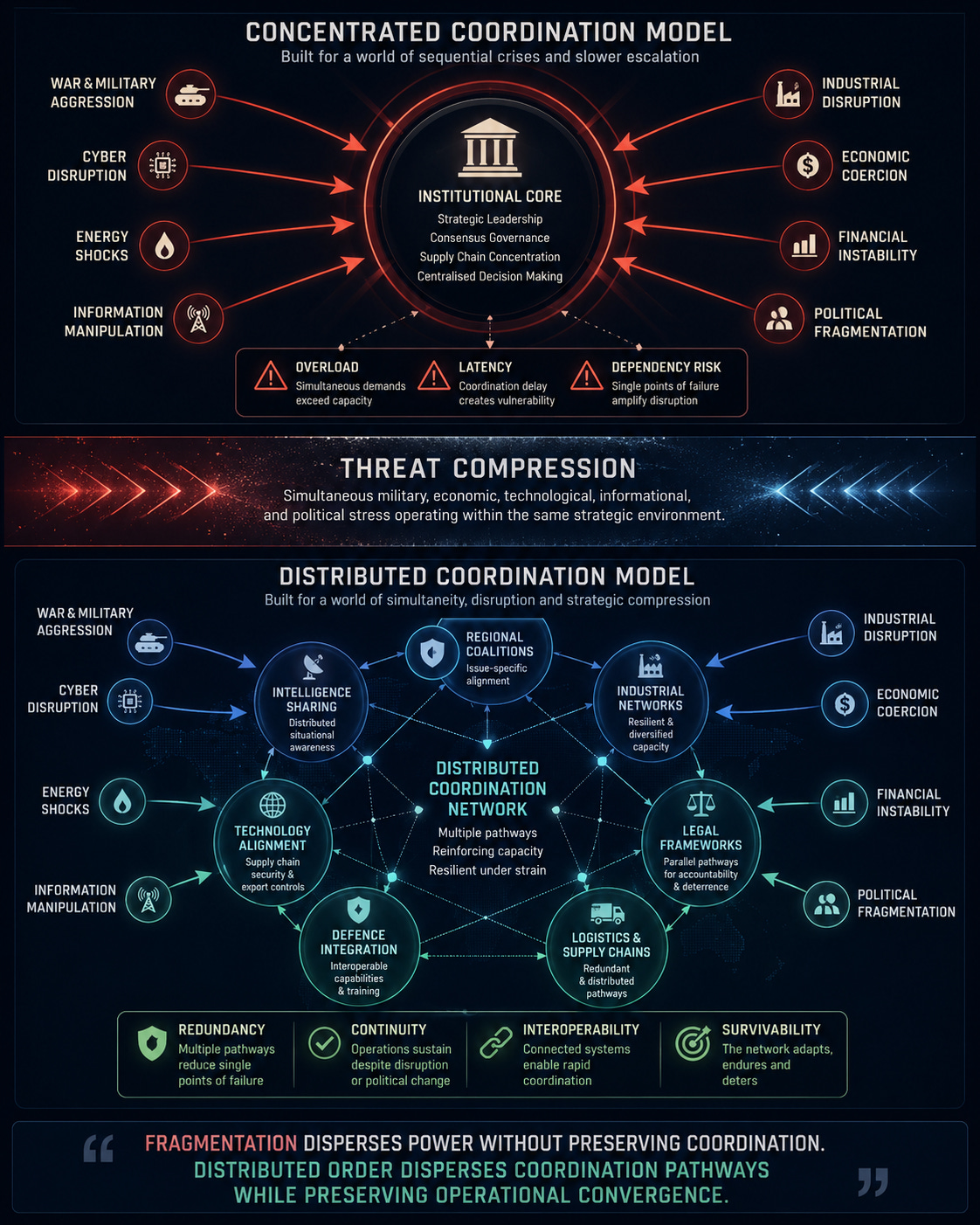
This convergence creates what may increasingly define the modern strategic environment:
threat compression.
Under conditions of threat compression, states no longer experience military, economic, technological, informational, and political pressures separately. They experience them simultaneously inside the same strategic environment.
Under these conditions:
institutions face overlapping demands simultaneously
attribution becomes contested
escalation timelines shorten
political bandwidth compresses
consensus mechanisms lag behind operational reality
local disruptions generate cascading effects across multiple domains at once
The challenge is no longer simply response capacity.
It is coordination survivability under simultaneous strain.
A second assumption has also weakened:
that concentrated strategic leadership can indefinitely absorb the burden of global coordination.
For decades, much of the democratic world operated under the assumption that the United States would remain the enduring coordination anchor of the international system.
The issue is not whether the United States retains its military, technological, industrial, financial, and institutional capabilities.
It does.
The issue is whether increasingly compressed strategic environments allow any singular coordination centre to indefinitely absorb simultaneous stress across multiple domains, theatres, and alliance systems without generating dependency fragility elsewhere in the network.
Under conditions of sustained polycrisis, even highly capable systems increasingly encounter strategic overload when coordination dependency becomes excessively concentrated.
The response has not been abandonment.
It has been diversification.
Middle powers increasingly deepen regional interoperability, expand defence-industrial coordination, diversify trade and energy pathways, and construct coalition frameworks designed to reduce systemic dependency concentration.
This process is not anti-American.
It is anti-fragility.
A third assumption has weakened alongside it:
that procedural consensus can operate at sufficient speed to manage compressed strategic environments.
Consensus-based governance functioned effectively in slower systems where:
institutions retained informational advantage
escalation unfolded gradually
negotiations remained temporally viable
strategic conditions remained relatively stable during deliberation
Under accelerated strategic conditions, these assumptions weaken significantly.
The gap between:
detection
institutional coordination
political consensus
operational response
has become strategically consequential.
Adversaries increasingly operate inside that latency.
Grey-zone coercion, cyber disruption, infrastructure sabotage, information manipulation, and economic pressure succeed not because democratic systems lack capability, but because procedural coordination structures increasingly struggle to respond at the speed demanded by compressed multi-domain environments.
The problem is not institutional incompetence.
It is structural latency.
States increasingly diversify coordination pathways because procedural delay now carries strategic cost. By distributing operational continuity across regional frameworks, industrial networks, coalition structures, and interoperable capability groupings, states reduce the strategic consequences of singular institutional paralysis.
Under compressed strategic conditions, systems capable of distributing coordination burdens across multiple interoperable pathways increasingly outperform systems dependent upon singular decision bottlenecks.
The strength of distributed coordination lies not in eliminating disruption, but in preventing disruption from paralysing the entire system simultaneously.
The final assumption now under strain is optimisation itself.
For decades, highly optimised systems were treated as inherently stabilising. Efficiency, integration, and concentration reduced costs and accelerated growth across:
logistics
manufacturing
finance
energy
information infrastructure
industrial production
But highly optimised systems often minimise redundancy.
Under conditions of structural stress, this increasingly produces vulnerability.
The disruptions exposed during:
the COVID-19 pandemic
the war in Ukraine
semiconductor shortages
maritime instability
cyber attacks
energy coercion
have accelerated a strategic shift already underway.
States increasingly prioritise:
resilience over efficiency
redundancy over optimisation
distributed production over concentrated dependence
strategic buffering over lean integration
The transition now underway is therefore not simply geopolitical.
It is structural.
II — UKRAINE AND THE EMERGENCE OF DISTRIBUTED ADAPTATION
The war in Ukraine did not create the pressures driving strategic adaptation.
But it accelerated and exposed them simultaneously.
The conflict became the first major stress test of the post-Cold War order under conditions of full-spectrum geopolitical compression.
What emerged in response was not a singular command structure or universally centralised alliance system.
Instead, states increasingly coordinated through multiple parallel pathways operating simultaneously across military, industrial, legal, technological, economic, and informational domains.
The Coalition of the Willing became especially significant in this regard.
Its importance lies not simply in military support for Ukraine itself, but in the coordination model it represents.
Participation varied across:
capability
geography
political exposure
industrial capacity
strategic risk tolerance
Yet operational continuity still emerged.
Military assistance, training systems, intelligence-sharing arrangements, sanctions enforcement, industrial procurement, and logistical support continued functioning even as participating governments changed, public pressure fluctuated, and burden-sharing debates intensified.
No singular actor controlled the entire coordination environment. Different states contributed different forms of capability according to capacity, geography, political tolerance, and industrial strength. The resulting system proved more flexible than many traditional consensus-based models operating under comparable escalation conditions.
This transition is also increasingly visible through distributed industrial mobilisation.
Ukraine’s wartime drone ecosystem evolved into a partially decentralised production environment involving state actors, private manufacturers, volunteer engineering communities, foreign industrial support pathways, and rapidly evolving procurement systems operating simultaneously across multiple jurisdictions. Innovation cycles accelerated because production and battlefield modification no longer depended entirely on singular centralised defence-industrial structures.
The same logic is increasingly visible elsewhere.
Nordic defence integration accelerated rapidly following Russia’s invasion of Ukraine. Finland and Sweden moved toward NATO membership while simultaneously deepening regional interoperability across intelligence, logistics, air defence, and operational coordination frameworks. NATO itself continues functioning as a major institutional anchor, yet deterrence capacity increasingly operates through reinforced regional layers within and around the alliance structure.
Parallel strategic coordination is also emerging within the technological domain.
Semiconductor alignment frameworks involving the United States, Japan, the Netherlands, Taiwan, and South Korea increasingly operate through export controls, industrial coordination mechanisms, technology restrictions, and supply-chain security arrangements designed to reduce vulnerability around concentrated strategic capability nodes.
Even legitimacy itself is becoming increasingly networked.
The emerging tribunal framework addressing Russian aggression demonstrates how states increasingly pursue legal coordination through parallel diplomatic and judicial pathways when traditional enforcement mechanisms remain constrained or politically paralysed.
These systems remain incomplete and uneven.
But collectively they reveal an important shift:
functional coordination is increasingly emerging through reinforcement across multiple pathways rather than singular centralised direction alone.
Ukraine therefore functions not merely as a regional war.
It functions as an observable transition environment in which the early architecture of distributed order is already beginning to emerge under conditions of sustained geopolitical compression.
III — THE HYBRID ORDER
The world is not transitioning cleanly from one order into another.
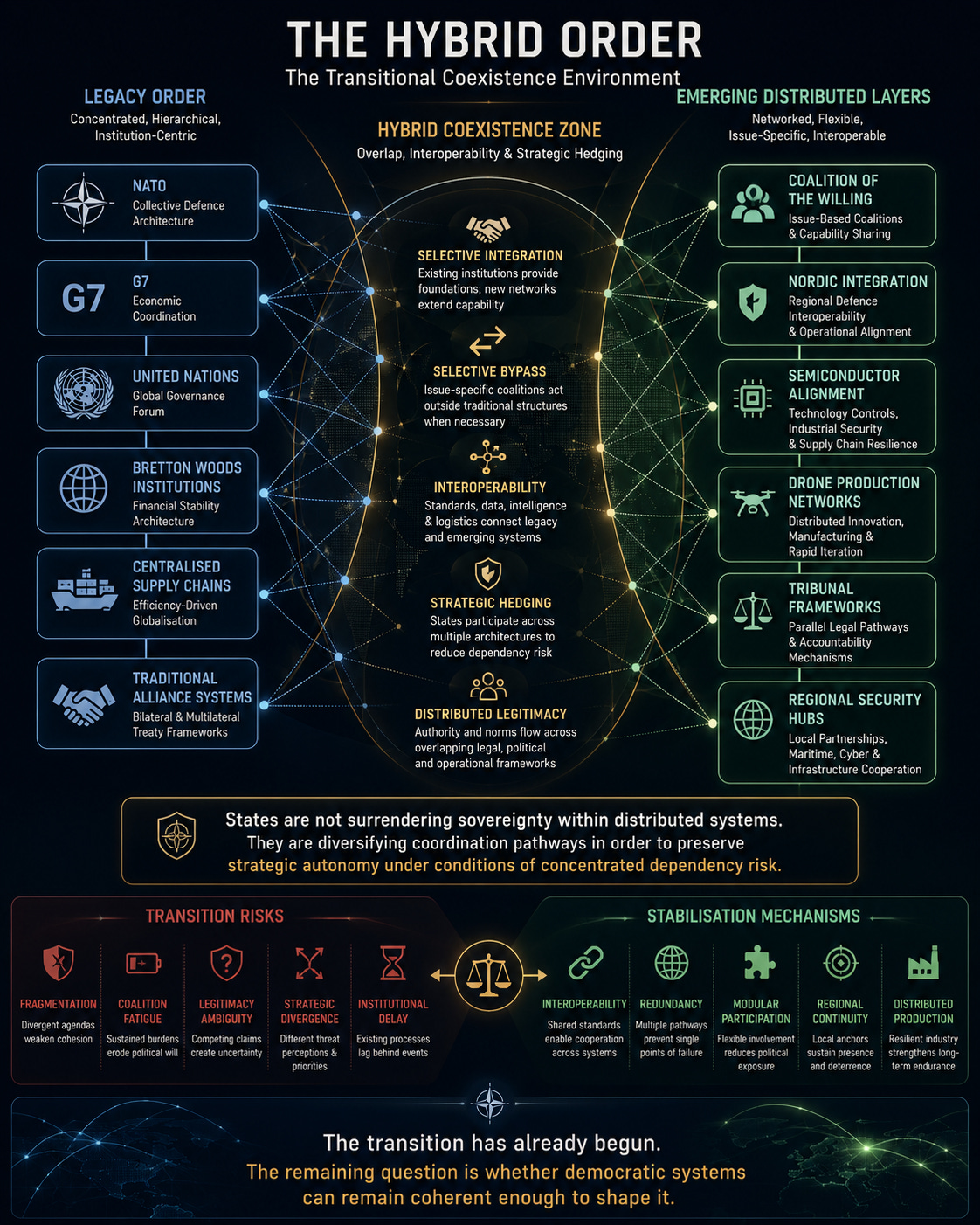
It is entering a prolonged hybrid phase in which:
hierarchical institutions
regional security architectures
coalition frameworks
legacy alliance systems
informal strategic networks
all coexist simultaneously.
This creates a structurally unstable environment.
The previous order continues functioning—but unevenly.
The emerging order operates—but incompletely.
The emerging order is not replacing the previous system cleanly.
It is forming unevenly inside it.
Under these conditions, institutions are selectively bypassed, states hedge across multiple frameworks simultaneously, and legitimacy increasingly disperses across overlapping coordination structures.
This is not temporary disorder.
It is transitional coexistence.
NATO continues functioning while parallel defence coordination expands outside its formal structure. The G7 remains influential while issue-specific coalitions increasingly shape sanctions, technology restrictions, industrial policy coordination, and strategic alignment. Regional partnerships deepen even while broader alliance frameworks persist.
The result is not the immediate replacement of the old order.
It is the gradual redistribution of coordination pathways around it.
This transition creates flexibility.
But it also creates instability.
Overlapping jurisdictions generate ambiguity regarding:
legitimacy
authority
escalation thresholds
operational responsibility
burden sharing
strategic accountability
Yet the hybrid phase also reduces transition shock.
States do not need to abandon existing alliances or institutions in order to diversify strategic pathways. Participation can deepen incrementally rather than through abrupt structural rupture. Regional interoperability can expand without requiring universal political consensus across the entire international system simultaneously.
States are not surrendering sovereignty within distributed systems.
They are diversifying coordination pathways in order to preserve strategic autonomy under conditions of concentrated dependency risk.
This matters because transition survivability increasingly depends on continuity rather than revolutionary replacement.
The hybrid order therefore functions not merely as an unstable intermediary phase.
It functions as a strategic buffer against fragmentation during periods of accelerated geopolitical transition.
IV — TRANSITIONAL INSTABILITY AND MANAGED ADAPTATION
The emergence of distributed order should not be mistaken for linear progress.
The transition itself introduces new vulnerabilities.
Strategic fragmentation, coalition fatigue, legitimacy ambiguity, operational inconsistency, industrial competition, and political divergence continue to exert strain across the emerging system simultaneously.
Not all participating states will share identical threat perceptions.
Not all coalitions will remain cohesive under prolonged stress.
Not all institutions will adapt at the same speed.
Adversaries will actively exploit these conditions.
Information warfare, cyber disruption, economic coercion, political interference, infrastructure sabotage, and institutional distortion are designed precisely to deepen fragmentation inside transitional environments where authority, legitimacy, and strategic alignment remain partially contested.
The greatest risk is therefore not direct military defeat alone.
It is incoherence.
The transition begins to fail when fragmentation outpaces coordination capacity.
This can occur through:
prolonged burden asymmetry
strategic divergence between coalition partners
institutional paralysis
industrial exhaustion
political fragmentation within democratic societies
escalating legitimacy competition between overlapping governance structures
Under these conditions, decentralisation alone becomes insufficient.
Survivability depends on whether states can preserve functional interoperability despite growing political and strategic divergence.
This is where transition stabilisation mechanisms become critical.
The Coalition of the Willing supporting Ukraine demonstrated that operational continuity could persist even under conditions of electoral change, fluctuating public support, uneven burden sharing, and differing political constraints across participating governments.
Ukraine’s drone production ecosystem demonstrated how industrial adaptation could continue despite sustained battlefield attrition and infrastructure strain by distributing innovation, procurement, manufacturing, and battlefield modification across multiple reinforcing production pathways.
Nordic defence integration demonstrated how regional interoperability can deepen even while broader debates regarding alliance burden sharing and long-term strategic cohesion continue unresolved across the wider system.
The tribunal framework addressing Russian aggression demonstrates how accountability systems can continue evolving through parallel legal and diplomatic structures even when traditional institutional consensus remains constrained.
These mechanisms do not eliminate instability.
They reduce transition vulnerability.
This distinction is critical.
The objective is not perfect coherence under strain.
It is the preservation of sufficient functional alignment to prevent instability from cascading into paralysis.
For many states, this increasingly makes diversified participation more attractive than isolated dependency concentration.
Modular participation lowers political exposure.
Regional interoperability reduces singular dependency risk.
Distributed industrial capacity reduces coercion vulnerability.
Institutional coexistence lowers transition shock.
Strategic diversification increases survivability during disruption.
The transition therefore becomes manageable not because instability disappears, but because stress is increasingly distributed across multiple reinforcing pathways rather than absorbed through singular dependency structures alone.
This remains uncertain.
The transition is not inevitable.
But the forces driving it are becoming increasingly difficult to ignore.
V — DISTRIBUTED ORDER UNDER PRESSURE
The emerging order is not being constructed according to a singular blueprint.
It is emerging through adaptation under strain.
The systems now developing across democratic coordination networks are responses to a strategic environment in which:
concentrated dependency increasingly produces vulnerability
institutional latency reduces responsiveness
polycrisis compresses escalation timelines
economic interdependence becomes coercive terrain
survivability increasingly depends on diversification and interoperability rather than concentration alone
The transition now underway should not be mistaken for the collapse of the existing order.
Legacy institutions remain powerful.
Major states remain central.
Traditional alliances continue functioning.
But the pathways through which coordination occurs are beginning to redistribute around them.
This is the critical shift.
States are responding accordingly.
Coalition structures, regional interoperability frameworks, industrial diversification systems, parallel legal mechanisms, and strategic coordination networks are not emerging because governments suddenly prefer decentralisation as an abstract principle.
They are emerging because modern strategic environments increasingly reward systems capable of sustaining functional continuity despite fragmentation, disruption, and institutional delay.
Fragmentation disperses power without preserving coordination.
Distributed order disperses coordination pathways while preserving operational convergence.
That distinction may become one of the defining geopolitical adaptations of the twenty-first century.
The Spiderweb Order therefore should not be understood as a future system waiting to be built.
Its early architecture is already beginning to emerge.
The transition has already begun.
The remaining question is whether democratic systems can remain coherent enough to shape it.