

Autonomy Under Pressure
Why Ethics and Strategy Can No Longer Be Separated

The Question Beneath the Noise
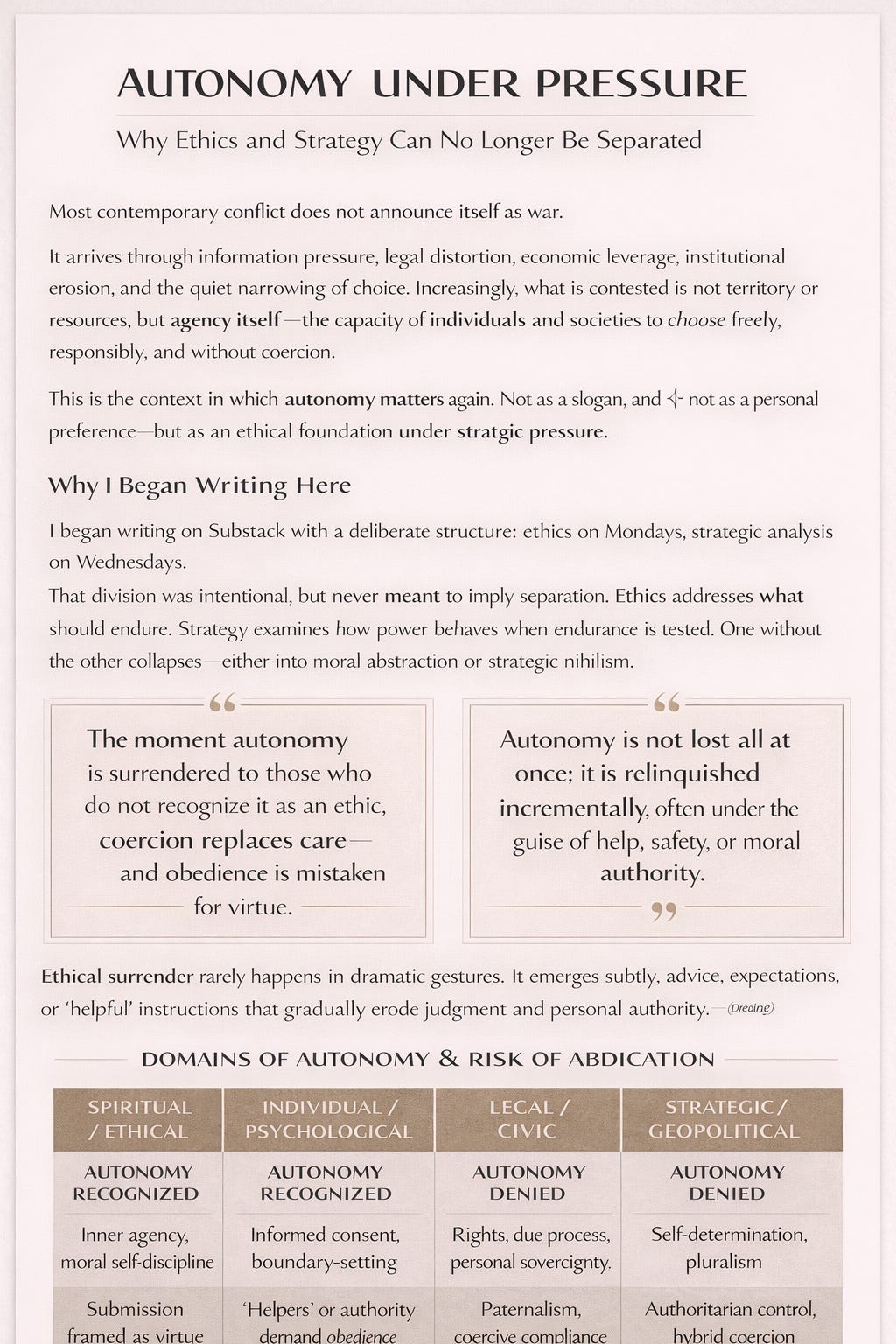
Most contemporary conflict does not announce itself as war.
It arrives through information pressure, legal distortion, economic leverage, institutional erosion, and the quiet narrowing of choice. Increasingly, what is contested is not territory or resources, but agency itself—the capacity of individuals and societies to choose freely, responsibly, and without coercion.
This is the context in which autonomy matters again. Not as a slogan, and not as a personal preference—but as an ethical foundation under strategic pressure.
Why I Began Writing Here
I began writing on Substack with a deliberate structure: ethics on Mondays, strategic analysis on Wednesdays.
That division was intentional, but never meant to imply separation. Ethics addresses what should endure. Strategy examines how power behaves when endurance is tested. One without the other collapses—either into moral abstraction or into strategic nihilism.
What compelled this structure was not academic curiosity. Across communities, institutions, and states, I began to observe the same pattern: decisions made faster, louder, and with greater confidence—yet with diminishing legitimacy. Autonomy was treated as inconvenient. Compliance was reframed as virtue. Control was mistaken for competence.
In such conditions, ethics becomes operational whether we acknowledge it or not.
The Ethical Core of Autonomy
Autonomy is more than choice—it is the precondition for responsibility, discernment, and ethical action. Without it, obligations and guidance lose meaning, and compliance may be mistaken for morality.
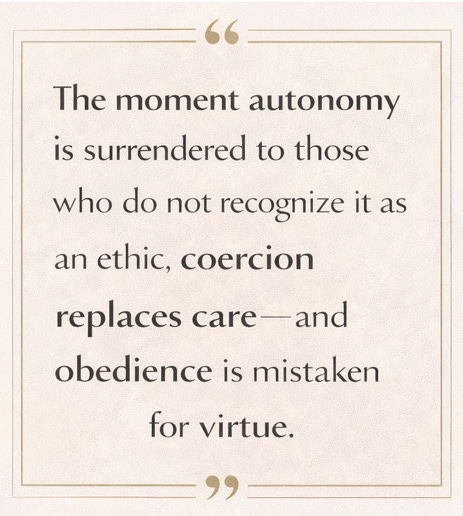
Ethically, autonomy requires vigilance. It is not permissive, but disciplined: a person or institution must recognise their own authority and the boundaries of others. Historical traditions—from Buddhist inner discernment to Enlightenment legal thought—have consistently linked autonomy to responsibility and resilience.
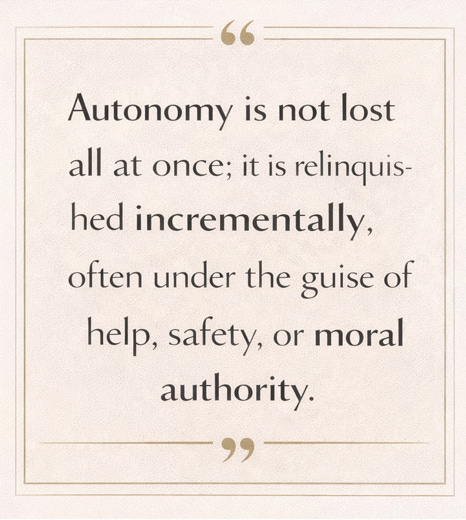
Ethical surrender rarely happens in dramatic gestures. It emerges subtly: advice, expectations, or “helpful” instructions that gradually erode judgment and personal authority.
A Personal Lesson in Ethical Abdication
I learned the cost of surrendering autonomy in the most direct way: trusted members of my community advised me to obey a certain individual completely—someone who was unstable, manipulative, and incapable of respecting anyone else’s agency. Following their guidance handed over my judgment, and almost immediately, it was used against me. The ethical shock of that moment was profound: even well-intentioned advice can become a tool for harm when autonomy is ignored.
This personal experience reflected a wider truth: systems that fail to safeguard independent agency invite coercion, misjudgement, and exploitation at every level. What happened to me on a small scale mirrors what occurs when ethical abdication is normalised in communities, institutions, and even nations.
From Personal Ethics to Geopolitical Insight
The principle of autonomy is not merely theoretical; it is vividly demonstrated in the resilience of the Ukrainian people. Since the annexation of Crimea and the full-scale invasion that began in 2022, Ukrainians have endured the assaults of autocratic power with courage, adaptability, and extraordinary agency. Their struggle illustrates what happens when autonomy is systematically attacked—both by external aggression and by the global community’s inconsistent ethical and strategic responses. Ukrainians have not only defended their sovereignty but have also issued a warning to the world: hybrid warfare, authoritarian drift, and the erosion of legitimate power are not abstract threats—they are present, observable, and urgent. Their autonomy, voice, and ethical agency have been tested at enormous cost, and their experience offers lessons in strategic resilience, legitimacy, and the indispensable role of ethical integrity in sustaining both national and global security.
Strategy Without Autonomy Is Fragile
From a strategic perspective, autonomy is not an ethical luxury—it is a resilience mechanism.
Systems that suppress autonomy may act faster, but they lose corrective feedback. Decision-making narrows. Adaptation becomes dangerous. Error compounds silently. Control produces the appearance of strength while hollowing out endurance.
“Control degrades resilience; autonomy enables it.”
This principle scales across institutions, alliances, and states. Hybrid warfare, authoritarian drift, and legal or economic coercion all exploit the erosion of autonomy.
Practical Implications
Autonomy as an ethic produces observable outcomes:
Institutions that respect agency adapt better under pressure
Policies grounded in consent endure longer than those imposed by force
Alliances built on choice outlast those built on coercion
Societies that preserve moral agency resist manipulation more effectively
These are not ideals. They are operational realities.
Closing: Why This Is a Foundational Piece
This article is pinned because it explains why this work exists.
Autonomy is not weakness. It is disciplined agency under pressure. It slows action, but strengthens outcomes. It preserves legitimacy where speed destroys it.
“Autonomy is the ethic that allows strategy to endure without hollowing itself out.”
If autonomy fails—ethically or strategically—everything built on it eventually follows. That is the terrain I write into.